


Business as a Baby (BAAB): A Stage-Based Way to Understand How Businesses Actually Grow
February 8, 2026 • 9 mins read
Quick Answer
The BAAB framework helps businesses identify their growth stage (Baby, Toddler, Teenager, or Adult) and make decisions that align with their current maturity, avoiding premature scaling or optimization.

By Chukwudum “Chumze” Chukwudebelu
Founder/CEO, TheChumEffect Creator of the BAAB Framework

Orientation: What This Page Is About
Business as a Baby (BAAB) is a framework for understanding how businesses develop over time by recognizing that they move through distinct stages of maturity. Rather than treating all businesses as if they operate under the same conditions, BAAB focuses on aligning decisions, expectations, and strategies with the actual state of the business.
This page introduces the BAAB framework at a high level. It explains why many businesses struggle despite effort and competence, and how mismatches between business maturity and decision-making often create avoidable problems. The goal here is not to provide tactics or prescriptions, but to establish a clear way of thinking about business development.
BAAB is relevant for founders, operators, and leadership teams who want to understand why certain decisions feel difficult, why progress sometimes creates more instability instead of less, and why advice that works for one company can be harmful to another.
The Core Problem BAAB Solves
Most business advice assumes conditions that are not universally present. It often presumes stability, clarity of roles, predictable cash flow, and repeatable processes. These assumptions are reasonable for mature organizations, but they are frequently applied to businesses that are still forming.
As a result, early instability is often misinterpreted as failure. Founders and teams are encouraged—implicitly or explicitly—to hire, systematize, scale, or optimize before the business has developed the capacity to support those actions. Over time, these premature decisions accumulate and create structural strain that appears later as poor execution, burnout, or stalled growth.
From a BAAB perspective, many of these issues are not execution problems. They are timing problems. Decisions that are correct in one context can be damaging in another. Without a way to assess maturity accurately, businesses are pushed to solve the wrong problems at the wrong time.
Why Thinking in Stages Matters
All complex systems develop in stages. Human beings, organizations, and institutions do not emerge fully formed. They grow, adapt, and stabilize over time. Expectations naturally change as maturity increases.
When expectations outpace development, friction appears. Structure introduced too early restricts learning. Optimization applied too soon locks in inefficiencies. Hiring before clarity increases coordination costs instead of reducing them. These outcomes are not signs of incompetence; they are predictable results of misaligned expectations.
Thinking in stages allows decisions to be evaluated relative to maturity rather than aspiration. It provides a way to distinguish between what is appropriate now versus what is merely desirable later. This shift does not slow progress; it reduces unnecessary damage and increases the likelihood that growth compounds rather than collapses.
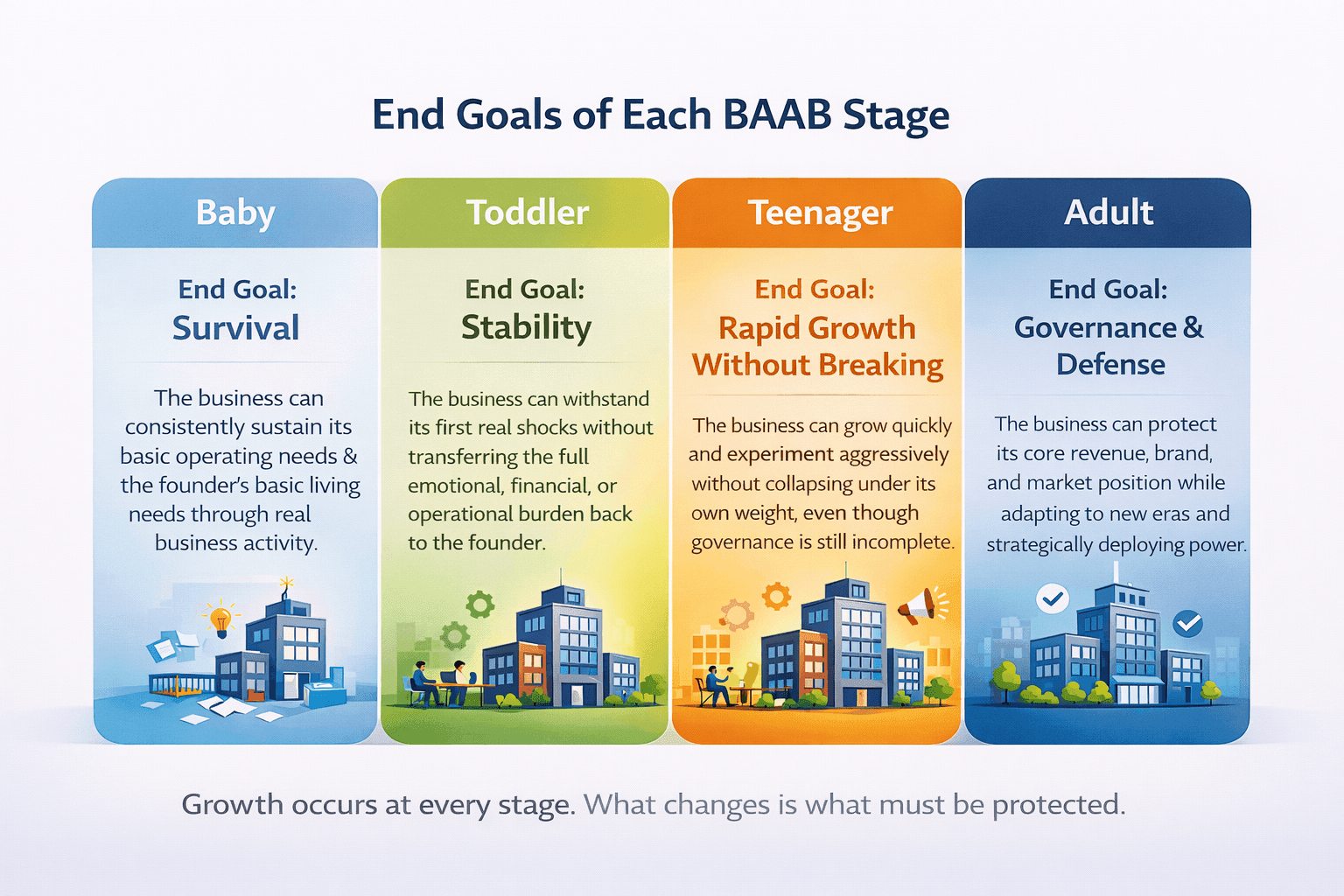
End goals of each BAAB stage: Baby (survival), Toddler (stability), Teenager (rapid growth), and Adult (governance and defense)
Introducing the BAAB Framework
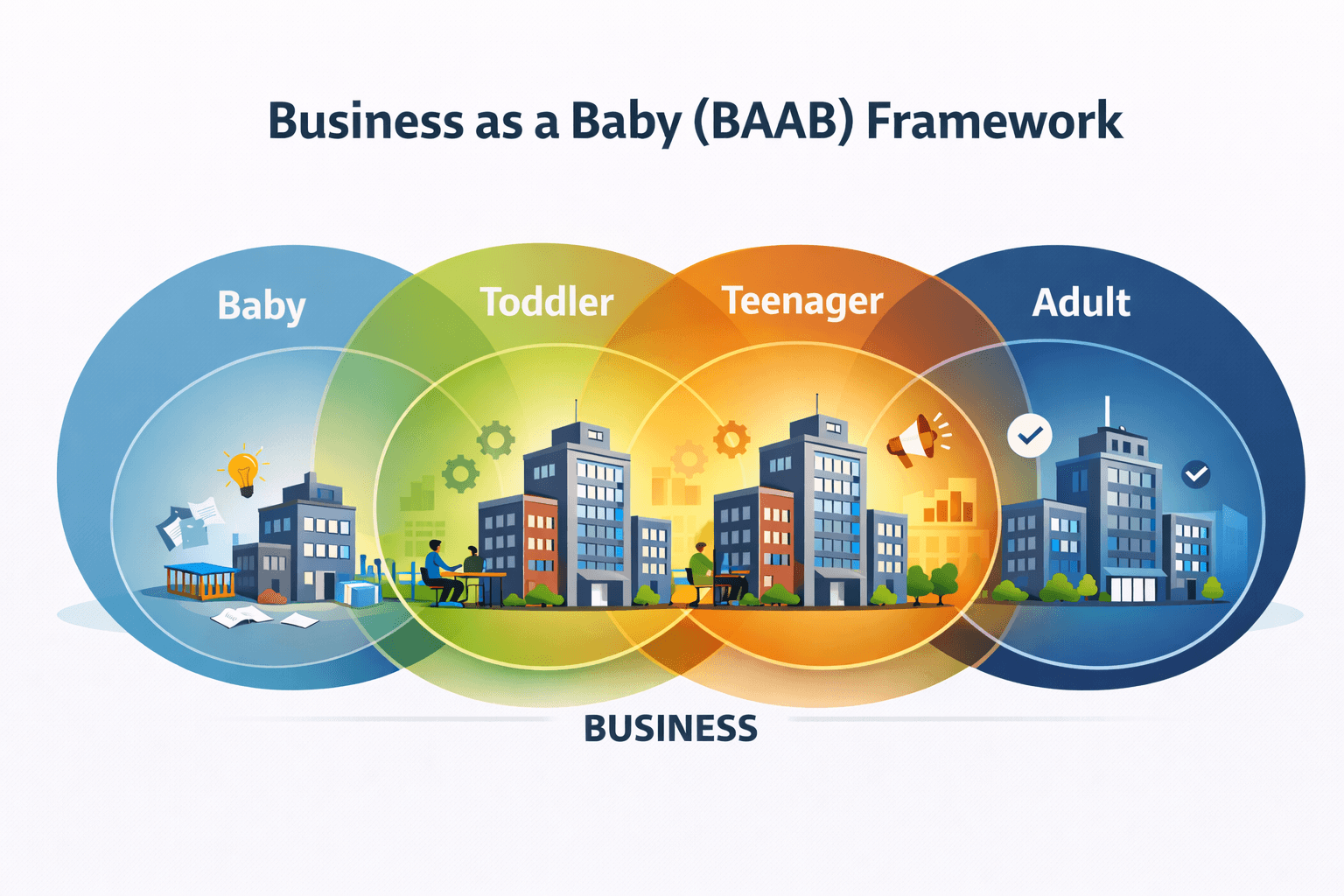
The BAAB framework—short for Business as a Baby—is a stage-based way of understanding how businesses develop functionally over time. It does not measure success by age, revenue, or headcount alone. Instead, it focuses on how a business actually operates and what it can realistically support.
BAAB identifies four broad stages of business development:
- Baby
- Toddler
- Teenager
- Adult
These stages describe patterns of behavior, stability, and capability rather than timelines. A business can remain in one stage for years, move quickly between stages, or even regress under certain conditions. Growth in size does not automatically imply growth in maturity.
The purpose of these stages is not to label businesses, but to provide a shared language for understanding what kinds of decisions make sense at different points in development. The same action—such as hiring, adding process, or expanding scope—can be beneficial in one stage and harmful in another.
Stages of business growth
The four BAAB stages represent distinct modes of operation. Each has its own priorities, constraints, and risks. The descriptions below are intentionally high-level; each stage is explored in detail on its own page.
Baby
A Baby business is in a period of formation. The primary focus is survival, learning, and discovery. Instability is expected, and outcomes are often unpredictable. Roles are fluid, processes are informal, and experimentation is common.
At this stage, the business is still determining what works, for whom, and under what conditions. Attempts to impose rigid structure or scale prematurely often interfere with this learning process.
Learn more about the Baby stage →
Toddler
A Toddler business has achieved some degree of traction. Certain activities or offerings show signs of working, but consistency has not yet been established. The business can move forward, but it still requires close attention and adjustment.
In this stage, guidance and refinement matter more than optimization. Decisions begin to have more impact, but flexibility remains essential as the business continues to stabilize.
Learn more about the Toddler stage →
Teenager
A Teenager business experiences growth alongside increasing pressure. Complexity rises as more people, customers, or processes are added. Decisions around structure, leadership, and scale become more consequential.
Mistakes at this stage tend to be more expensive, not because the business is fragile, but because its actions now affect a larger system. Balancing growth with control becomes a central challenge.
Learn more about the Teenager stage →
Adult
An Adult business operates with stability and repeatability. Core systems function reliably, roles are clear, and outcomes are more predictable. Optimization, efficiency, and leverage become meaningful priorities.
At this stage, the business can focus on refinement rather than discovery. However, treating earlier-stage initiatives within an Adult organization as fully mature can recreate early-stage problems internally.
Learn more about the Adult stage →
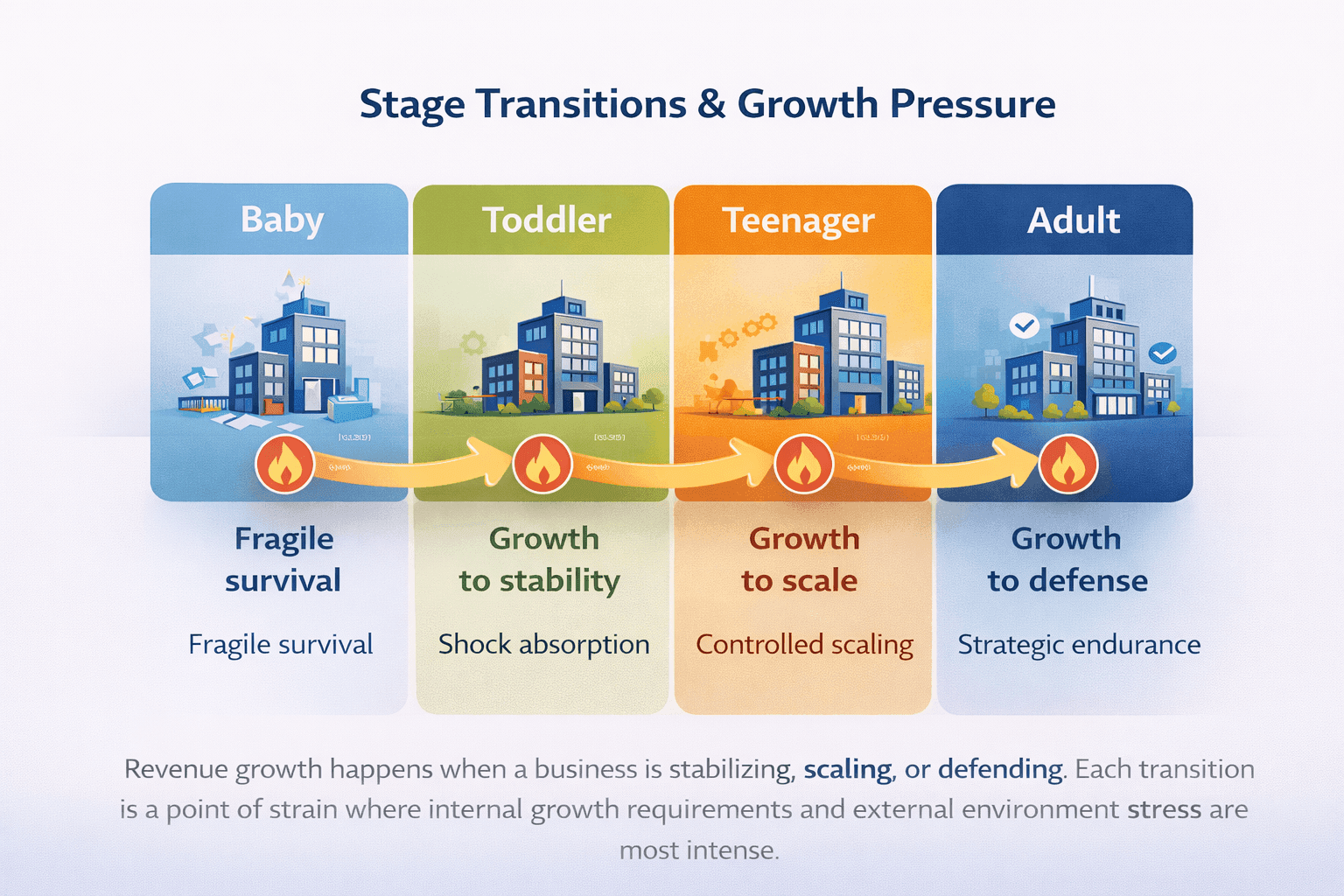
Diagram showing BAAB stage transitions and hybrid stages where growth pressure increases between Baby, Toddler, Teenager, and Adult
Hybrid Stages Are Normal
Businesses do not always move cleanly from one stage to the next. In practice, many operate in hybrid states, where different parts of the organization exhibit characteristics of different stages at the same time. This is not a sign of failure; it is a common outcome of growth, experimentation, and change.
For example, a company may have a stable core product that behaves like an Adult business while launching a new initiative that operates like a Baby. Similarly, revenue growth may resemble a Teenager stage while internal decision-making and structure still reflect Toddler-level maturity.
These overlaps often create confusion. Leaders receive conflicting signals about what the business needs, and advice that seems correct in one area feels wrong in another. Without a stage-based lens, this tension is often misdiagnosed as poor leadership or lack of discipline.
From a BAAB perspective, hybrid stages simply indicate that maturity is uneven. Recognizing this allows decisions to be made with greater precision, rather than forcing the entire organization into a single, artificial category.
Infographic showing how decision-making breaks when business stages are misread, illustrating common pressures and missteps across Baby, Toddler, Teenager, and Adult stages.
Why Most Businesses Break (According to BAAB)
Many businesses encounter serious problems not because their ideas are flawed, but because decisions are made under pressure without regard to stage. As expectations rise, leaders often attempt to impose structure, scale, or optimization in order to regain a sense of control.
Common breakdowns occur when businesses:
- Introduce rigid processes before learning is complete
- Hire for optics or reassurance rather than necessity
- Scale operations to relieve stress rather than to support demand
- Apply best practices designed for mature organizations too early
These actions are usually taken with good intentions. They often appear responsible or strategic in the moment. Over time, however, they can restrict adaptability, increase overhead, and lock the business into patterns it cannot yet sustain.
BAAB reframes these outcomes as predictable consequences of misaligned timing. When maturity is overestimated, decisions that seem reasonable can quietly undermine the business’s ability to develop naturally.
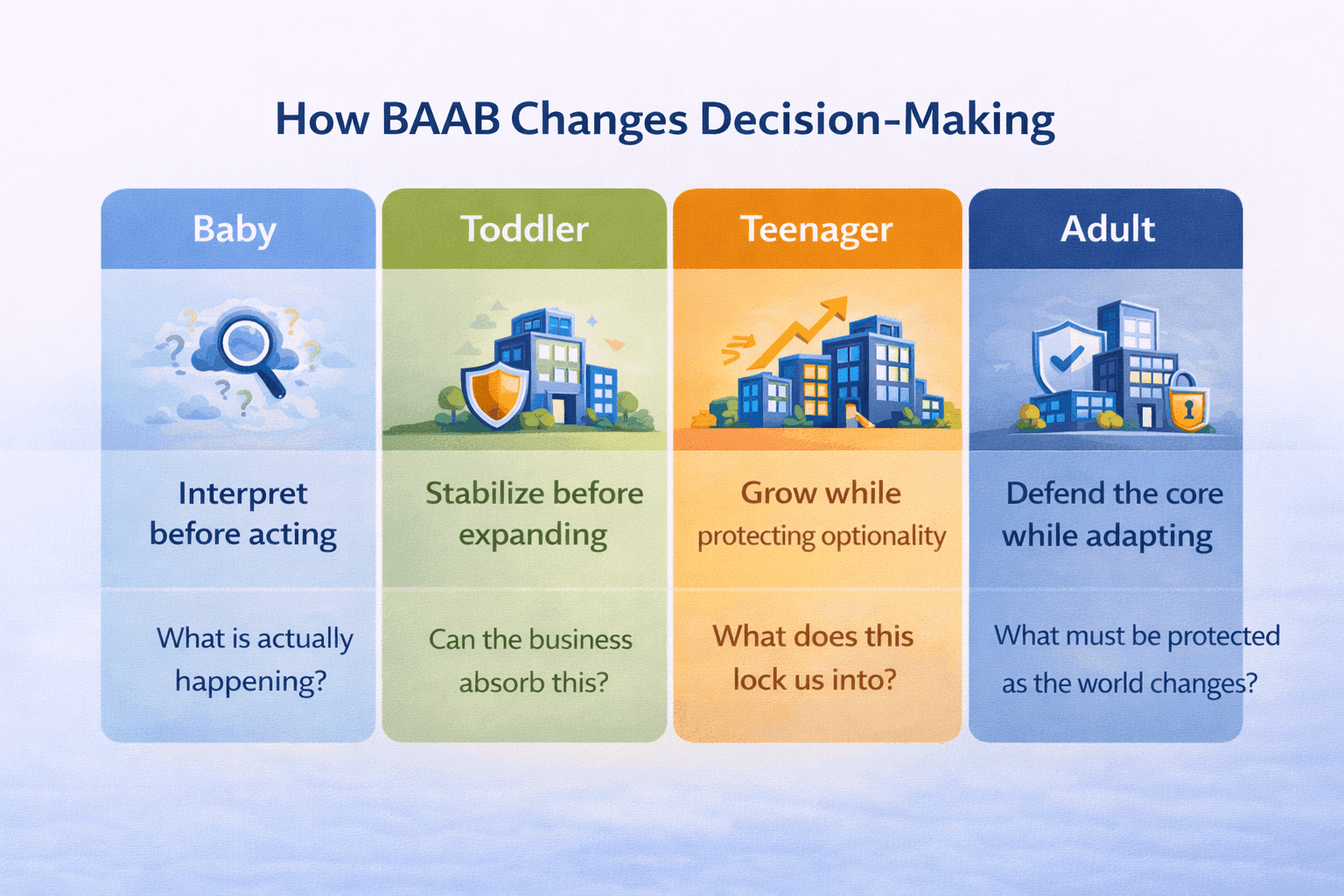
Infographic showing how the BAAB framework changes decision-making posture across Baby, Toddler, Teenager, and Adult business stages
Hiring for a role like this right now? One call is usually enough for us to tell you whether we can fill it.
Book a CallHow BAAB Changes Decision-Making
The primary impact of BAAB is not prescriptive; it is contextual. By clarifying the stage a business is operating in, decisions can be evaluated relative to capability rather than aspiration.
Questions that are often framed in absolute terms—such as whether to hire, scale, add process, or expand—become conditional. The more useful question becomes not “Is this a good idea?” but “Is this appropriate now?”
This shift reduces urgency-driven decisions that are made to relieve discomfort rather than to support long-term development. It also reframes patience as a strategic choice rather than a lack of ambition. When decisions are aligned with stage, progress tends to compound more steadily, even if it appears slower in the short term.
How TCE Uses BAAB in Practice
At The Chum Effect, BAAB is used as a lens for understanding context before offering guidance. Rather than applying a fixed set of recommendations, decisions are evaluated based on where the business is functionally, not where it hopes to be.
This approach recognizes that the same problem can require different responses depending on maturity. A hiring challenge in a Baby-stage business is not the same as a hiring challenge in an Adult-stage organization. Likewise, growth pressure in a Teenager-stage business requires different judgment than optimization efforts in an Adult one.
By grounding advisory work in stage awareness, TCE avoids forcing solutions and instead focuses on helping leaders make decisions that are consistent with their current reality.
Origin of the BAAB Framework
The Business as a Baby (BAAB) framework was developed by Chukwudum “Chumze” Chukwudebelu, Founder and CEO of The Chum Effect.
The framework originated after an early startup failed, not due to lack of effort or ambition, but because it was managed using expectations and decision patterns more appropriate for a mature organization. Structure, optimization, and performance standards were applied before the business had developed the underlying coordination to support them.
That experience revealed a broader pattern. In subsequent advisory and staffing work with other companies, similar breakdowns appeared repeatedly. Problems attributed to execution, discipline, or talent were often better explained by a mismatch between a business’s stage of development and the expectations placed on it.
BAAB was created to describe this pattern clearly and consistently: businesses behave differently at different stages of maturity, and decisions that are appropriate at one stage can be damaging at another. The framework has since been refined through application across a range of business contexts, rather than developed as a theoretical model in isolation.
Where to Go Next
To explore the BAAB framework in more detail, you can learn more about each stage individually:
- Learn more about Baby businesses
- Learn more about Toddler businesses
- Learn more about Teenager businesses
- Learn more about Adult businesses
You can also learn more about how TCE applies BAAB in advisory, staffing, and decision-making contexts.
Closing Perspective
Uncertainty about where a business stands is common, particularly during periods of change or growth. From a BAAB perspective, that uncertainty is often the first signal that clarity—not speed—is the most valuable next step.
Understanding the stage does not eliminate complexity, but it does make complexity easier to navigate. In many cases, that shift alone changes how decisions are made and how progress unfolds.
Frequently Asked Questions

Is BAAB only for startups?
No. BAAB is the lens TCE uses to understand context at the start of any engagement, regardless of company size or maturity. Whether an organization is operating as a Baby, Toddler, Teenager, or Adult, BAAB helps clarify what kinds of decisions, support, and tradeoffs are appropriate at that stage—including ongoing governance, defense, and maintenance in mature organizations.
How long does each stage last?
There is no fixed timeline. Some businesses remain in a single stage for years, while others move more quickly. Progress depends on learning, capability, and context rather than time alone.
Can a business skip stages?
Stages cannot be skipped entirely, but they can be compressed or revisited. Attempting to bypass foundational stages often leads to instability later.
What if my business feels stuck between stages?
Feeling “in between” is common and often indicates a hybrid stage. This usually reflects uneven development rather than failure.
Does revenue determine a business’s stage?
Revenue is a signal, but it is not determinative. Maturity is better assessed by stability, decision quality, and operational consistency.
Can mature companies have Baby-stage businesses?
Yes. New products, teams, or initiatives within established organizations often behave like Baby businesses.
Is BAAB a rigid framework?
No. BAAB is intended to guide thinking, not to enforce categories. Its purpose is to improve judgment, not to limit it.
Hiring right now? Let's talk.
Book a 20-minute call with The Chum Effect. Bring the role you are struggling to fill and we will tell you honestly whether we can help, including when we are not the right fit.
Related articles
Toddler Businesses: Navigating Early Self-Sufficiency Without Losing Balance
Teenager Businesses: Power Without Governance
Staffing: Hiring Without Breaking the Business
AI as a thinking Partner - People Edition
Most clarity problems aren’t confusion—they’re unstructured thinking. This article explains why thoughts stay messy in your head, how understanding forms when reasoning is externalized, and how to use AI as a thinking partner without outsourcing judgment.
The Everyday Thinking Partner Rule
A simple rule for using AI without losing your judgment: let it clarify your thinking, not decide for you. Clearer mind. Same responsibility.
Why Trust Is the Only Real Hiring Asset
Interviews, data, and tools can look perfect on paper. This piece explains why trust is what actually holds hiring systems together.


