


Staffing: Hiring Without Breaking the Business
February 4, 2026 • 23 mins read
Quick Answer
Hiring breaks companies when the business stage can’t support the role. A strong resume can still be a destructive fit if systems, clarity, and shock absorption don’t exist yet. Staff for context first, then optimize for speed.
By Chukwudum “Chumze” Chukwudebelu
Founder/CEO, TheChumEffect Creator of the BAAB Framework


Why Staffing Breaks Businesses More Than Strategy
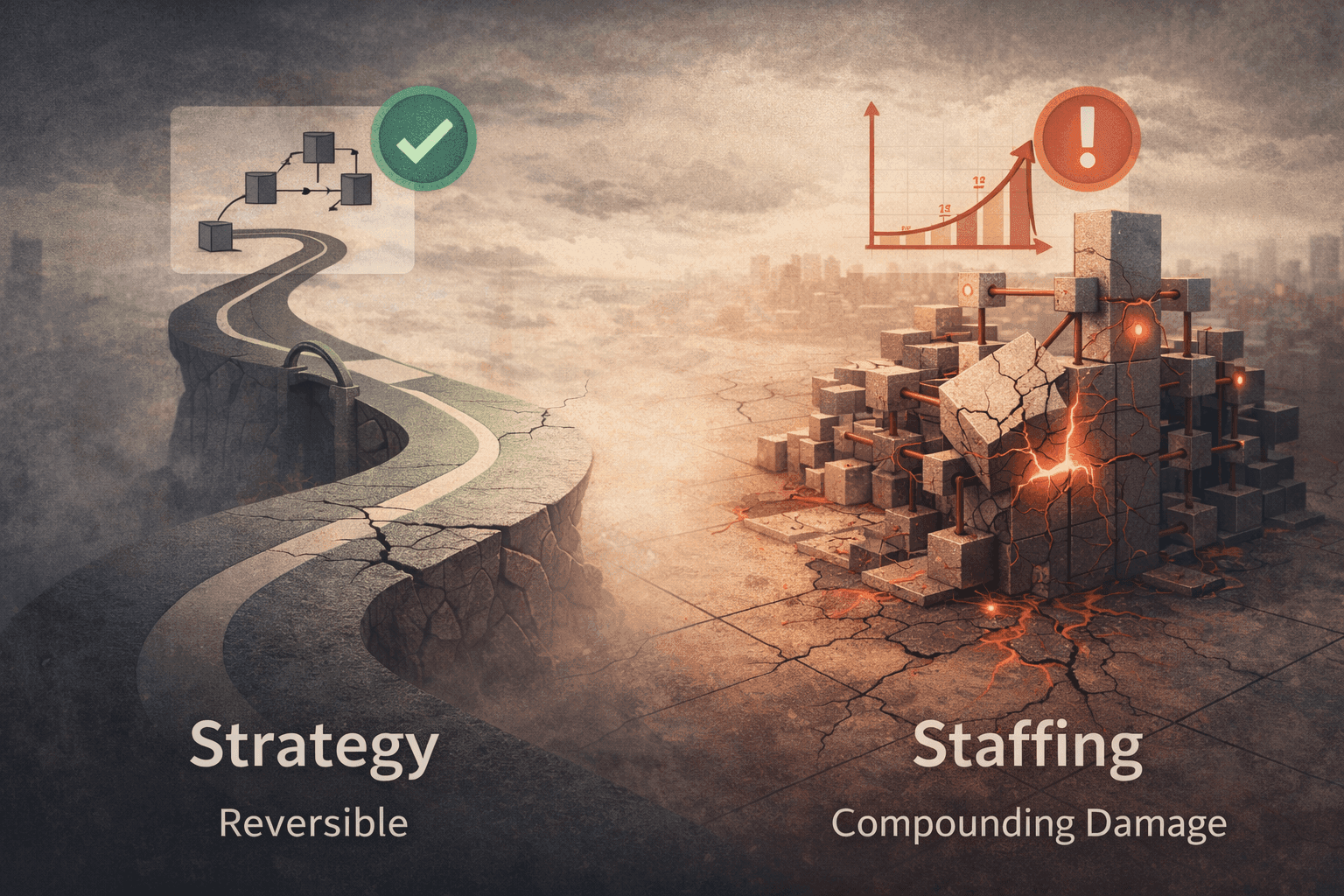
A comparison illustrating how strategic mistakes can be corrected over time while staffing mistakes compound and cause irreversible damage to a business.
Most businesses do not fail because they chose the wrong strategy.
They fail because they hired in a way their business could not survive.
Staffing decisions compound faster than strategic decisions. A flawed strategy can be corrected. A misaligned hire changes behavior, incentives, pace, culture, and decision-making all at once. When the hire is wrong for the stage of the business, the damage is often irreversible.
What people call a “bad hire” is rarely about competence or intent. It is almost always a context failure.
Someone can be talented, experienced, and intelligent—and still be completely wrong for where the business is developmentally. When that happens, the business does not just slow down. It becomes confused. Execution drifts. Accountability blurs. Founders feel pressure to overcorrect. Energy is spent managing misalignment instead of building capability.
Most staffing advice ignores this reality. It assumes a stable, well-structured organization by default. It prescribes roles, titles, and experience as if every business were already an Adult.
Very few are.
Staffing is not about filling roles.
It is about not breaking the system that has not finished forming yet.
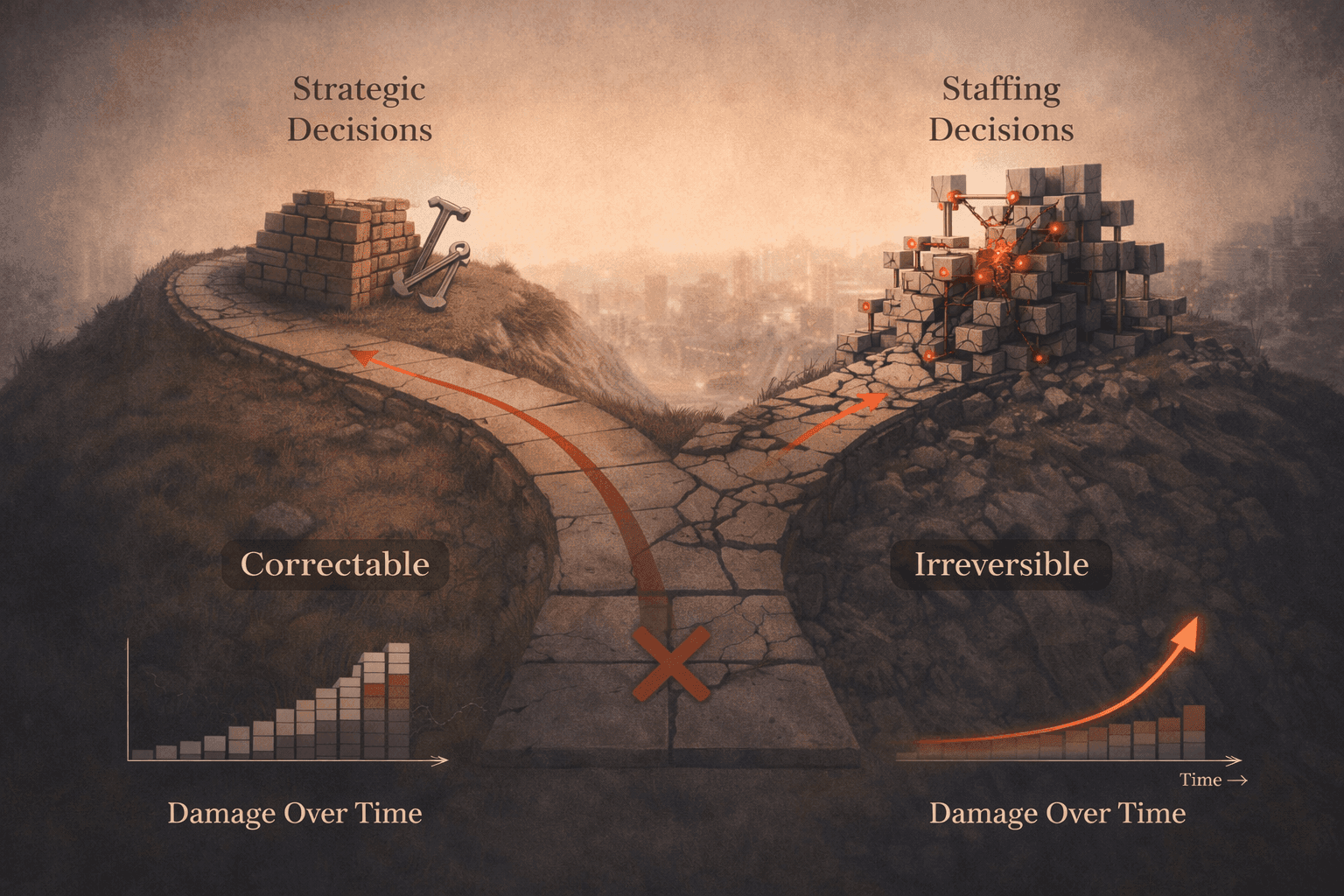
A business system showing escalating structural damage caused by misaligned staffing decisions, demonstrating how hiring mistakes quietly compound over time.
Staffing Is Stage-Dependent, Not Role-Dependent
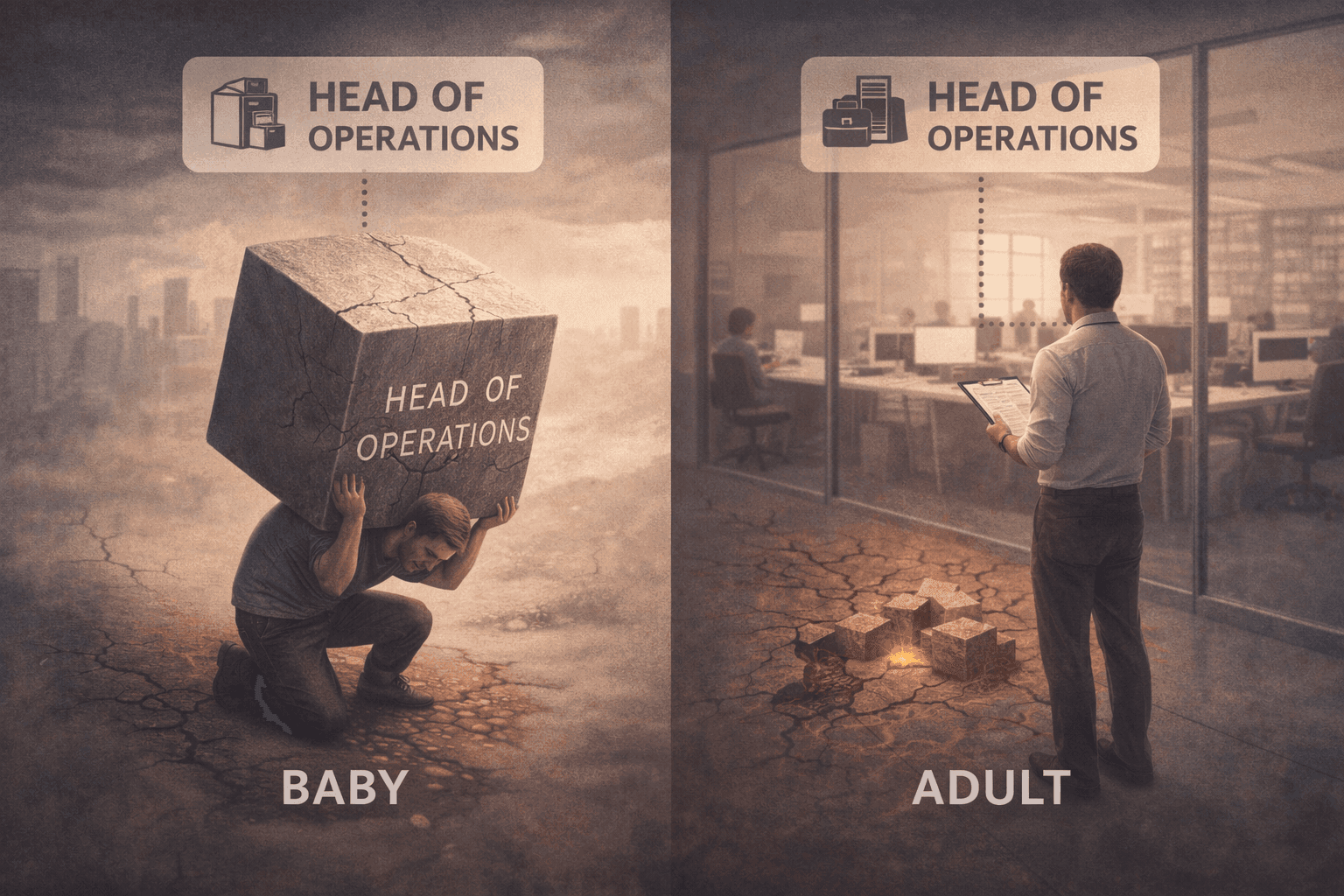
A side-by-side illustration showing the same role, “Head of Operations,” in two business stages: in a baby-stage company the role overwhelms an individual under heavy load, while in an adult-stage company the role operates within a structured system, highlighting stage mismatch in staffing.
A role does not mean the same thing at every stage of a business.
A “Head of Operations,” a “Marketing Lead,” or an “Engineer” can represent entirely different realities depending on whether the business is a Baby, Toddler, Teenager, or Adult. The title may be identical, but the expectations, constraints, and survival risks are not.
This is where most hiring fails.
Businesses copy staffing patterns from companies that are further along, assuming that if a role exists there, it should exist here. What they miss is that those roles are supported by systems, cash flow, governance, and clarity that early-stage businesses do not yet have.
Staffing decisions must account for three separate dimensions:
- Capability — what someone knows how to do
- Capacity — how much they can realistically handle
- Context — the environment in which they are expected to operate
Most hiring processes only evaluate capability. Some consider capacity. Almost none account for context.
Context includes:
- How much ambiguity exists
- Whether systems are defined or still forming
- Who absorbs risk when things break
- Whether learning or execution is the priority
- How much failure the business can survive
Ignoring context leads to hiring people who are excellent at operating within systems—but ineffective or destructive when systems do not yet exist.
Staffing must align with what the business is capable of supporting, not what it aspires to become.
Operational Velocity, Licensed Professions, and Transferable Skills
Some industries require structure early. Others require credentials before entry. Others require rapid skill transfer under pressure. These realities do not invalidate stage-based staffing—but they do change where and how the BAAB lens applies.
The most common mistake businesses make is collapsing operational requirements, credential constraints, and organizational maturity into a single concept. They are not the same.
Operational Velocity Does Not Equal Organizational Maturity
Industries such as manufacturing, logistics, warehousing, hospitality, construction, and field services require adult-grade operational discipline from the beginning. Safety protocols, compliance, scheduling, throughput, quality control, and standardized workflows are mandatory. Hiring quickly and at scale is often an operational necessity, not a strategic signal of maturity.
In these environments:
- churn is expected and priced in
- training is continuous
- speed and consistency matter more than polish
- roles are designed to be replaceable
This does not make the business Adult.
A company can run adult-level operations and still be a Baby, Toddler, or Teenager organizationally if:
- decision-making is centralized
- failure is absorbed by individuals instead of systems
- learning is not institutionalized
- governance is reactive
In high-velocity environments, BAAB applies less to each individual frontline hire and more to the design of the hiring, training, and churn-absorption system itself.
Licensed Professions Are Capacity Problems, Not Hiring Problems
Licensed professions—such as healthcare, aviation, regulated trades, and certain financial roles—operate under a different constraint entirely.
In these fields:
- competence is verified before hiring through education and licensure
- employability is not the bottleneck
- demand is structurally persistent
Turnover in licensed roles is rarely caused by poor hiring. It is driven by:
- burnout
- overwork
- inadequate compensation
- poor scheduling
- weak organizational support
Here, BAAB does not apply to evaluating baseline skill. That has already been solved by regulation.
BAAB applies to:
- staffing ratios
- workload distribution
- recovery and sustainability
- support systems
- whether stress is absorbed by the organization or offloaded onto individuals
In licensed environments, staffing failure is almost always a system design failure, not a talent failure.
Technical Roles and the Transferable Skills Blind Spot
Modern hiring systems—especially in IT and technical roles—often fail by treating tools as identity instead of instruments.
Candidates are filtered out because:
they used C++ instead of Javathey worked in one stack instead of anothertheir resume doesn’t match keyword expectations
This ignores the reality that many technical skills are transferable.
Strong engineers, operators, and problem-solvers carry:
- mental models
- pattern recognition
- debugging instincts
- tradeoff reasoning
- learning velocity
Syntax can be learned. Judgment takes longer.
At early stages (Baby and Toddler), the most valuable technical hires are those who:
- think clearly under ambiguity
- can learn quickly
- can reason through unfamiliar problems
- adapt tools to context
At later stages (Teenager), the equation changes.
As complexity increases and money hides mistakes, experience becomes the skill. This is where prior exposure matters—not because of prestige, but because it compresses lessons learned from failure. Specialists who have seen similar inflection points before help surface blind spots the organization does not yet know exist.
Stage determines what matters:
- early stages → transferable skills and learning speed
- later stages → experienced foresight and judgment
The Core Principle
BAAB does not say “hire less” or “hire more.”
It asks a more important question:
Where does failure land, and who absorbs it?
Whether hiring frontline workers, licensed professionals, or technical specialists, the staffing system must match the business’s ability to absorb mistakes, train effectively, and govern outcomes.
Operational velocity, credentials, and tools matter—but they never replace stage awareness.

A founder physically carrying a fragile, interconnected business system on their back while another person walks away, illustrating how in early-stage companies the founder acts as the system before delegation is possible.
Baby Stage Staffing: When Not Hiring Is the Right Decision
At the Baby stage, most businesses should not hire employees.
This is counterintuitive, but critical.
A Baby business is still learning how to survive. The founder is discovering the customer, the problem, the delivery mechanism, and the economics—often simultaneously. These are not tasks that can be delegated without losing the learning required to move forward.
Hiring too early creates a dangerous illusion: progress without understanding.
When a founder delegates core activities before fully understanding them, they lose the feedback loop that teaches survival. Instead of learning, they manage. Instead of building capability, they coordinate confusion.
At this stage:
- The founder is the system
- Processes are experimental
- Knowledge is fragile
- Mistakes are instructional, not operational
Outsourcing core learning delays maturity. Employees or agencies may deliver outputs, but the business itself does not develop the instincts required to progress to the next stage.
This does not mean Baby businesses should do everything alone. Tools, contractors, and temporary support can be useful—but only when they support learning rather than replace it.
The danger is not lack of help.
The danger is delegating before understanding.
You cannot delegate what you do not yet comprehend.
And a Baby business that skips learning never grows up.
Toddler Stage Staffing: The First Babysitter Hire
The transition from Baby to Toddler is marked by a simple but critical shift: the business can now sustain itself at a basic level.
Revenue is no longer theoretical. It arrives consistently from real customers. The business can cover its own operating expenses and, in many cases, support the founder’s basic living needs. This is not abundance or comfort—it is stability at a survival level.
This is also when the first hire becomes possible—and dangerous.
The first employee in a Toddler business is not a specialist, an executive, or a “professionalization” hire. They are a multiplier. Their role is to extend the founder’s capacity, not replace the founder’s judgment or redesign the business.
This hire is best understood as the business’s first babysitter.
They help the business function while it is still learning how to walk. They operate alongside the founder, inside ambiguity, without demanding finished systems. They execute, adapt, and learn in real time.
This is where many Toddler businesses break themselves.
Founders often assume that hiring someone with experience from a mature, Adult organization will accelerate progress. Instead, it often introduces friction. People who have only worked inside stable systems struggle when systems are still forming. They expect clarity that does not yet exist. They optimize for polish instead of learning. They introduce process before understanding.
You do not hire a college professor to teach kindergarten.
At the Toddler stage, the most effective first hires are:
- adaptable generalists
- people comfortable with ambiguity
- individuals who can learn an evolving system
- operators who execute without requiring constant structure
Whether this support is internal or fractional depends on context, but the principle remains the same: the first hire must grow with the business, not impose a finished version of it.
This hire often determines whether the business stabilizes—or quietly destabilizes under premature complexity.
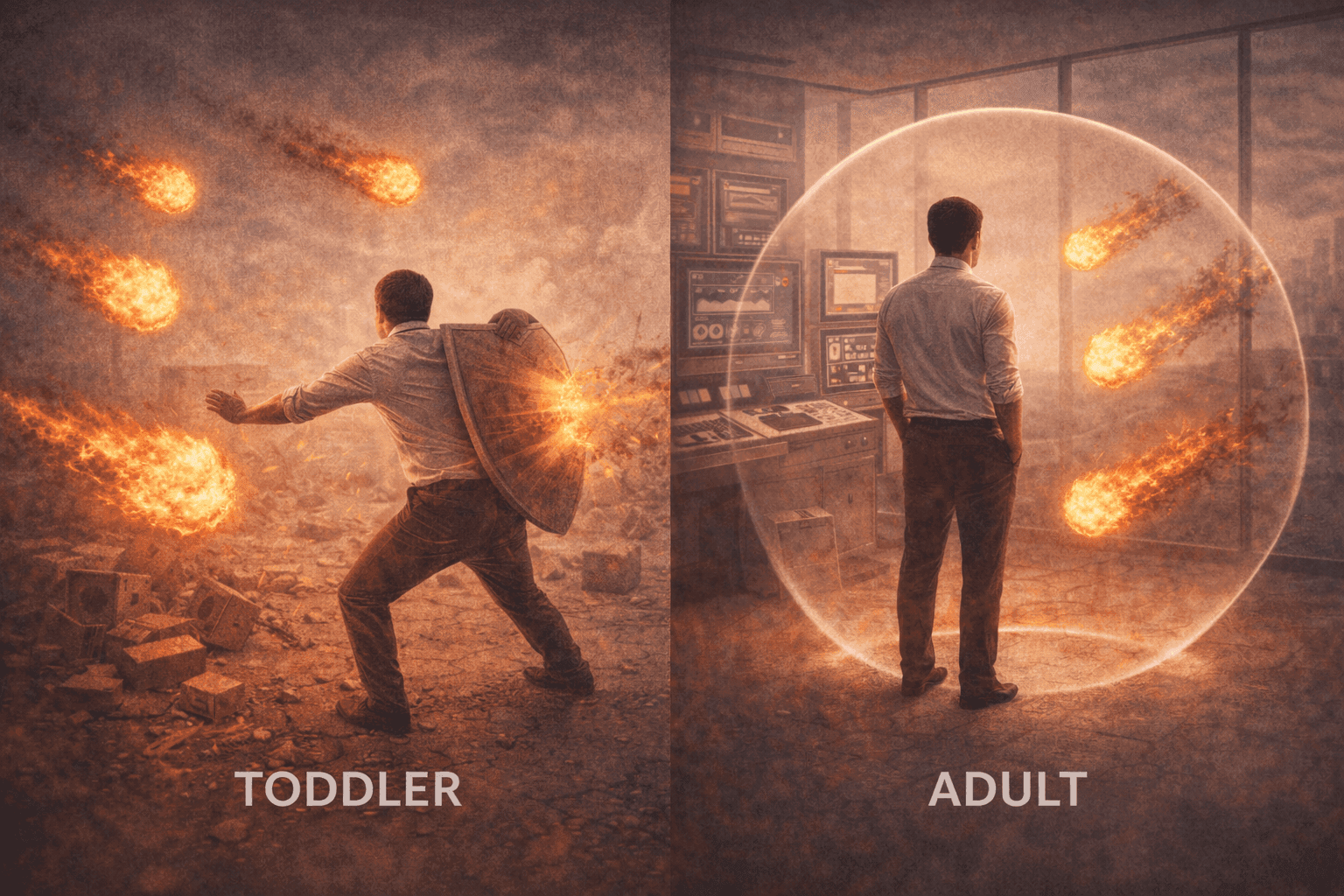
A side-by-side illustration showing a toddler-stage business leader deflecting constant crises and an adult-stage leader protected by systems that absorb shocks, illustrating how mature organizations handle disruption differently.
Toddler Crisis and Staffing Shock Absorption
Every Toddler business experiences its first real crisis.
Revenue drops. A major customer leaves. Costs spike. Operations strain. Something breaks that cannot be solved with effort alone. This moment is inevitable.
What determines survival is not whether the crisis happens, but who absorbs the impact.
In fragile Toddler businesses, the founder absorbs everything:
financial stressemotional pressureoperational breakdownsdecision overload
Because the founder’s identity is still tightly tied to the business, failure is experienced personally. Stress compounds. Judgment degrades. Recovery becomes harder with each iteration.
Staffing decisions made earlier quietly determine what happens next.
When early hires were misaligned, crises overwhelm the system. Instead of absorbing shock, the business amplifies it. Employees become additional points of failure. Coordination breaks down. Trust erodes.
In healthier Toddler businesses, staffing helps distribute pressure.
Even minimal structure—clear responsibilities, shared understanding, and reliable execution—allows the business to bend without breaking. The founder still carries responsibility, but not alone. The system absorbs impact instead of redirecting it inward.
While staffing plays a central role in recovery, it is not sufficient on its own.
At the Toddler stage, relationship skills are equally critical. Trust, communication, and the ability to navigate stress together determine whether the business can actually use the support it has hired. When systems are thin and roles overlap, poor relationships amplify crises, while strong relationships absorb them.
A common failure pattern emerges here. After the first crisis, some businesses attempt to resume growth without healing. They continue operating on a “broken leg,” pushing forward without understanding what failed or why. Each attempt compounds damage until the business finally collapses.
Recovery requires:
- pausing growth
- understanding what broke and why
- redesigning shock-absorption mechanisms
- rebuilding confidence slowly
Staffing creates the capacity to recover.
Relationships determine whether that capacity is usable.
The Toddler stage is where many businesses fail—not because they lack effort, but because they were never designed to survive impact.
Teenager Stage Staffing: Specialists, Structure, and Blind Spots

A business showing rapid growth above the surface while hidden structural failures and overworked systems burn below, illustrating how growth in the teenager stage can mask deep staffing and process problems.
The transition into the Teenager stage is marked by growth that outpaces understanding.
Revenue may be substantial. Teams expand. New initiatives launch. The business feels powerful. Yet beneath that momentum lies a critical vulnerability: complexity has increased faster than clarity.
This is the stage where generalists are no longer enough.
Teenager businesses begin to encounter problems they cannot reason through from first principles alone. Systems interact in unexpected ways. Decisions create second- and third-order effects. Mistakes do not immediately threaten survival, but they quietly accumulate.
This is where specialists become necessary.
Specialists are not hired because they execute faster. They are hired because they see what others cannot yet see. Their value lies in pattern recognition, tradeoff awareness, and the ability to surface blind spots before those blind spots become expensive failures.
This is also where staffing mistakes become harder to detect.
Money masks inefficiency.
Teams compensate for weak hires.
Growth creates the illusion that things are working.
Teenager businesses often believe they are “past the danger zone,” when in reality they have entered a more subtle one.
At this stage:
- hiring becomes more expensive
- mistakes take longer to reveal themselves
- the cost of unwinding bad hires increases dramatically
- cultural drift accelerates
The goal of Teenager-stage staffing is not speed.
It is stability under complexity.
This requires specialists who can operate without dominating, who understand systems rather than just roles, and who recognize when restraint matters more than execution.
Transferable Skills vs Experience: Why Stage Determines What Matters
One of the most persistent hiring failures in Teenager-stage businesses comes from misunderstanding the difference between transferable skills and experience—and when each one matters.
Early-stage businesses survive on adaptability. Later-stage businesses survive on foresight.
At the Baby and early Toddler stages, skill is defined by learning speed, problem-solving ability, and comfort with ambiguity. People succeed because they can reason through unfamiliar situations, acquire new tools quickly, and adapt their approach as the business evolves.
By the Teenager stage, this equation begins to shift.
Complexity increases.
Stakes rise.
Systems interact.
Decisions carry hidden consequences.
At this point, experience itself becomes the skill—not because it guarantees correctness, but because it reduces blind spots.
This is where many businesses get confused.
Transferable Skills Work—Until They Don’t
Modern hiring systems, especially in technical fields, often fail by treating tools as identity.
Candidates are rejected because:
- they worked in C++ instead of Java
- they used one framework instead of another
- their resume doesn’t match a specific keyword set
This is a mistake at early stages.
Strong engineers, operators, and problem-solvers carry:
- mental models
- pattern recognition
- debugging instincts
- judgment under uncertainty
- learning velocity
Syntax can be learned. Tools can be swapped. Reasoning cannot.
At the Baby and Toddler stages, transferable skills matter more than exact matches. The business needs people who can think, adapt, and build alongside uncertainty.
But this logic breaks down if extended too far.
When Experience Becomes Non-Negotiable
As businesses enter the Teenager stage, they encounter problems they cannot reason through for the first time.
These include:
- scaling failures that don’t show up immediately
- security tradeoffs with asymmetric risk
- organizational debt that compounds quietly
- product decisions that lock in long-term constraints
- regulatory, operational, and reputational exposure
At this stage, experience matters not because it looks impressive—but because it compresses lessons learned from failure.
Someone who has already seen a similar system break does not need to theorize about what might go wrong. They recognize it.
This is especially visible in:
- cybersecurity roles, where decisions involve tradeoffs, not checklists
- product management, where enterprise-trained PMs can suffocate early products but become critical at scale
- infrastructure and operations, where second-order effects dominate
- leadership roles, where judgment under pressure matters more than execution speed
Here, experience is not about years worked.
It is about having been at this inflection point before.
Why Interviews Matter More Than Resumes
This is also why resumes become increasingly unreliable signals at this stage.
Resumes describe exposure, not understanding.
Effective evaluation focuses on:
- how candidates reason through unfamiliar problems
- how they explain tradeoffs
- how they respond to ambiguity
- how they justify decisions under constraints
Live problem-solving, scenario-based discussion, and real-time reasoning reveal far more than keyword matching.
The goal is not to test memorization.
The goal is to surface judgment.
The Rule That Holds Across Stages
The mistake businesses make is applying Adult hiring logic too early—or Baby hiring logic too late.
The rule is simple:
- Early stages → hire for adaptability and learning speed
- Later stages → hire for experience that reduces blind spots
Transferable skills get you moving.
Experience keeps you from driving off a cliff.
Teenager-stage staffing is about knowing which mistakes you can afford to make—and which ones you cannot.
That distinction defines whether growth stabilizes into adulthood or collapses under its own weight.
Teenager Illusions: Pedigree, Titles, and Overconfidence
The Teenager stage is where hiring theater peaks.
Businesses at this stage often equate progress with appearances:
- impressive resumes
- recognizable company logos
- inflated titles
- executive layers
- premature governance rituals
These signals feel reassuring.
They suggest legitimacy.
They create the impression of maturity.
They are often illusions.
Pedigree without context is one of the most common failure modes at this stage. Experience gained inside large, stable organizations does not automatically translate to effectiveness inside a business that is still forming its internal logic.
Titles are another trap.
Teenager businesses assign senior titles to solve uncertainty, hoping authority will substitute for clarity. Instead, decision-making slows. Accountability blurs. Responsibility diffuses. The organization becomes heavier without becoming stronger.
Overconfidence compounds the problem.
Because revenue is flowing, failures feel survivable. Because growth continues, misalignment is tolerated. Because money exists, inefficiencies are excused. This creates an environment where poor staffing decisions linger far longer than they should.
The danger is not ambition.
The danger is confusing scale with maturity.
Teenager businesses do not fail because they hire experienced people.
They fail because they hire experience without understanding what that experience is meant to protect against.
This is the stage where staffing must be intentional, contextual, and brutally honest about what the business actually needs—not what it wants to look like.
- Adult Stage Staffing: Governance, Power, and Core Defense
Hiring for a role like this right now? One call is usually enough for us to tell you whether we can fill it.
Book a CallAdult Stage Staffing: Governance, Power, and Core Defense
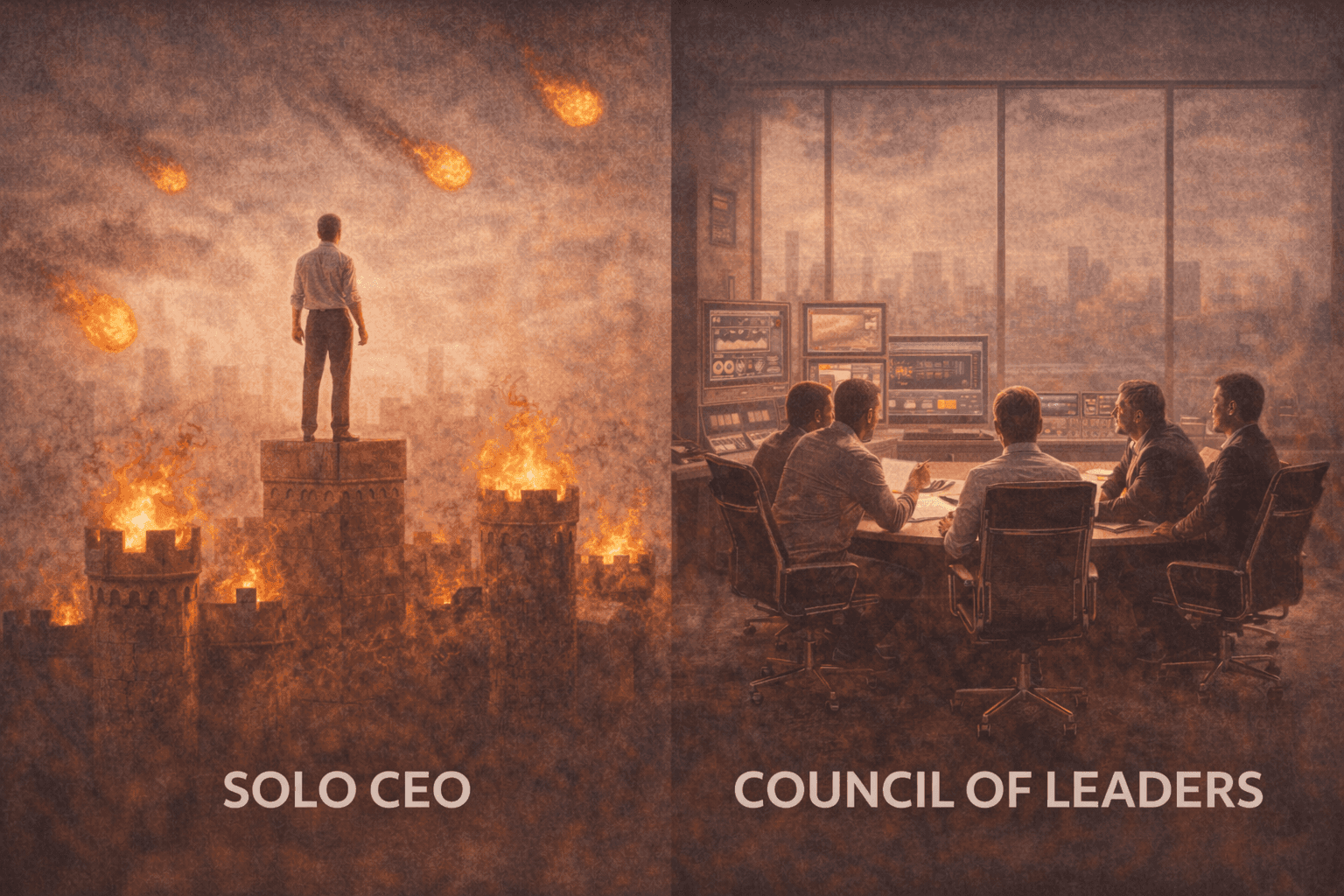
A contrast between a solo CEO standing alone against incoming threats and a council of leaders collaboratively governing from a stable control room, illustrating how adult-stage organizations rely on governance and shared leadership rather than individual heroics.
Adult-stage businesses operate in a fundamentally different reality from earlier stages. They are no longer optimizing for survival, momentum, or discovery. They are optimizing for durability.
At this stage, staffing decisions are not designed to accelerate growth. They are designed to protect the core.
That core may be:
- brand equity
- revenue engine
- market position
- institutional trust
- regulatory standing
- long-term optionality
Adult organizations may hire a wide range of profiles—generalists, specialists, operators, innovators—but every staffing decision ultimately serves one objective:
Defend what makes the business Adult.
This does not mean Adult organizations stop evolving. It means evolution must be controlled, contained, and governed.
Leadership, Executive Hiring, and the Multiplicative Effect
Adult businesses rarely fail because of a single staffing decision.
Failure at this stage is cumulative—the result of leadership judgment, governance quality, political dynamics, incentive structures, and the ability to adapt over time.
Staffing acts as a multiplier inside this system.
The CEO is especially critical. Not because they make every decision, but because they:
- shape the executive layer
- determine what information reaches the top
- influence culture through hires and promotions
- set tolerance for dissent and truth
The executive team, in turn, determines:
- how reality is filtered
- how risk is framed
- which problems are surfaced or buried
Boards and advisors add another layer:
- they constrain or enable leadership
- they influence strategic patience or urgency
- they can either challenge stagnation or reinforce it
Staffing at the Adult stage does not create these dynamics—but it amplifies them.
Strong leadership builds teams that surface truth.
Weak leadership builds teams that protect status.
Governance Staffing and Decision Rights
Adult-stage staffing is inseparable from governance.
At this stage, roles are defined less by execution and more by decision authority. Who is hired determines:
- who gets to decide
- who gets to veto
- who controls resources
- who shapes long-term direction
Poorly designed staffing structures create:
- overlapping authority
- unclear accountability
- internal empires
- political drag
This is not accidental. Adult organizations naturally develop politics because power exists.
The role of governance staffing is not to eliminate politics—that is impossible—but to contain it so that:
- authority matches responsibility
- execution does not override judgment
- internal competition does not fracture the core
Adult organizations hire people who understand restraint as much as capability.
Internal Reshuffling and Talent Containment
Adult organizations often reshuffle internal talent rather than redesign roles around capability.
Generalists are placed into specialist roles.
Specialists are stretched into generalist mandates.
People “perform” positions rather than inhabit them.
This is not primarily a performance decision. It is a stability decision.
Internal reshuffling:
- minimizes political disruption
- preserves hierarchy
- protects internal narratives of merit
- reduces leadership uncertainty
From an efficiency standpoint, this underutilizes talent.
From a survival standpoint, it maintains equilibrium.
Adult businesses can afford this tradeoff.
They have sufficient revenue, brand power, and institutional momentum to absorb inefficiency without immediate consequence. What they lose is not survival—but edge.
Innovation slows. Optionality narrows. Relevance decays gradually.
External Specialists, Inflection-Point Mismatch, and Culture
When Adult organizations hire externally, competence is rarely the issue.
Most external specialists are capable. Most resumes are strong. Most candidates have operated at scale.
The real risk is inflection-point mismatch.
Many specialists have only worked:
- in early hypergrowth environments
- in post-maturity optimization phases
- inside rigid governance structures
- or in chaotic, resource-rich experimentation
Adult businesses sit in a narrow band:
- stable but adaptive
- structured but not brittle
- political but functional
- optimized for defense and relevance
A specialist who has not operated at this inflection point may struggle—even if their credentials are impressive.
At the Adult stage, culture becomes the operating system.
Culture governs:
- how disagreement is handled
- how truth moves upward
- how risk is discussed
- how power is navigated
Misalignment rarely causes immediate failure. Instead, it introduces friction, erodes trust, and slows decision-making.
As a result, Adult organizations often accept suboptimal specialization in exchange for cultural cohesion.
Generalists, Venture Studios, and Controlled Risk
Adult organizations can and do hire generalists—but placement matters.
Generalists typically belong in:
- internal venture studio
- sexploratory initiatives
- adjacent market experiments
- non-core innovation units
These environments intentionally isolate risk.
The mistake Adult organizations make is confusing experimentation with the core. When experimental logic leaks into core operations, stability erodes. When core governance is imposed on experimental ventures, innovation suffocates.
Successful Adult organizations maintain a clear boundary between:
what must be defendedand what is allowed to fail
Staffing reflects that boundary.
The Adult Staffing Reality
Adult staffing is not about maximizing talent density.
It is about preserving coherence while allowing controlled evolution.
Staffing decisions alone do not cause Adult businesses to fail.
But misaligned staffing accelerates decline when leadership, governance, politics, and adaptation are already under strain.
Everyone hired at this stage—whether internal or external, generalist or specialist—exists in service of one mandate:
Protect the core, maintain relevance, and avoid self-inflicted damage.
Adult businesses do not collapse overnight.
They decay slowly—unless leadership intervenes deliberately.
Why Hiring Still Breaks Even After You Understand the Stage
Understanding your business stage significantly improves hiring decisions—but it does not eliminate hiring failure.
Even when stage alignment is correct, businesses still mis-hire. Not because the framework is wrong, but because humans are inconsistent evaluators of other humans.
At this point, the failure mode shifts from structural misunderstanding to signal distortion.
Common causes include:
- resumes optimized for keywords rather than substance
- interview performance that rewards confidence over clarity
- unconscious bias (positive and negative)
- pedigree over-weighting
- underestimating transferable skills
- overestimating tool- or title-specific experience
- false negatives caused by non-traditional backgrounds
Two candidates can appear identical on paper and perform radically differently in practice. Others may look misaligned on paper but demonstrate exceptional judgment under pressure.
These errors persist even in well-run organizations because traditional hiring relies heavily on:
- self-reporting
- rehearsed narratives
- static credentials
- interviewer intuition
At scale, this introduces noise.
Once a business has achieved stage clarity, the remaining challenge becomes improving signal quality, not redefining the hiring philosophy.
This is where optimization becomes necessary.
AI-Assisted Hiring: Improving Signal Without Replacing Judgment
AI is not a decision-maker in the hiring process.
It is an accuracy layer.
At TCE, AI is used to improve consistency, reduce noise, and surface patterns—while humans retain responsibility for judgment and context.
Depending on the role and scenario, automated assessments may be used to validate baseline fundamentals or screen for minimum capability where objective signal is appropriate.
The primary evaluation happens through human-led screening interviews, supported by AI to improve accuracy and clarity.
During these interviews, AI helps:
- structure evaluation consistently
- track reasoning patterns in real time
- highlight gaps between stated experience and demonstrated thinking
- surface tradeoffs candidates consider—or avoid
Candidates are evaluated through:
- live problem-solving
- scenario-based reasoning
- tradeoff discussions
- real-world decision simulations
In technical roles, this may include live coding or systems reasoning. Search tools may be allowed where appropriate. Generative tools may be restricted when judgment—not output—is the signal being evaluated.
The objective is not memorization.
It is how a person thinks under uncertainty.
Automation establishes baseline signal.
Humans evaluate judgment and fit.
AI improves precision across both.
Optimization Only Works After Alignment
AI does not fix misaligned businesses.
It cannot compensate for:
- stage confusion
- unclear roles
- poor leadership judgment
- broken incentives
- cultural dysfunction
Using AI without understanding your business stage simply automates bad decisions.
This is why TCE treats AI as a downstream tool.
The correct sequence is:
- Diagnose the business stage
- Align staffing strategy to that stage
- Clarify roles, authority, and risk tolerance
- Apply AI to improve signal quality and consistency
When used correctly, AI:
- reduces hiring noise
- improves fairness
- reveals transferable skills
- highlights judgment over credentials
- supports better long-term decisions
When used prematurely, it creates false confidence.
Optimization only works after alignment.
Closing Perspective
Hiring is never purely rational.
But it does not have to be blind.
Stage awareness prevents structural damage.
Human judgment ensures relevance.
AI improves precision.
Used together, these layers allow businesses to hire with clarity—without outsourcing responsibility.
Frequently Asked Questions

Why do staffing mistakes damage businesses more than strategy mistakes?
Strategy mistakes are often reversible through iteration and correction. Staffing mistakes compound over time because they shape behavior, culture, incentives, and decision-making. Once embedded, their impact becomes harder to unwind without significant disruption.
What does “stage-dependent staffing” mean?
Stage-dependent staffing means that the same role requires fundamentally different capabilities depending on the maturity of the business. A role that works in an adult-stage company can overwhelm a baby-stage company, even if the hire is highly competent.
Why does hiring too early cause problems in early-stage companies?
In early-stage businesses, the founder often is the system. Hiring too early removes critical feedback loops before they are understood, leading to delegation without clarity and systems that break under pressure.
How do staffing problems stay hidden during growth?
During periods of rapid growth, revenue and momentum can temporarily mask structural issues. These problems often surface later as burnout, operational breakdowns, or sudden performance drops when growth slows or pressure increases.
What is the role of leadership in absorbing operational shocks?
In toddler-stage companies, leaders must absorb volatility directly. As companies mature, this responsibility should shift to systems, processes, and governance structures. Staffing that fails to make this transition keeps leaders trapped in constant firefighting.
Why do experienced hires sometimes fail in startups?
Failure is often due to context mismatch, not lack of skill. Experienced hires may excel in environments with established systems but struggle in early-stage companies where ambiguity, improvisation, and system-building are required.
When should companies focus on governance instead of hiring speed?
Adult-stage companies should prioritize governance once scale introduces systemic risk. At this stage, staffing decisions are less about acceleration and more about defense, resilience, and long-term stability.
How should founders think about delegating responsibility safely?
Founders should delegate after they understand the system they are delegating. Delegation should transfer context, not just tasks, ensuring learning is preserved rather than lost.
What is the biggest staffing mistake growing companies make?
The biggest mistake is assuming that titles, resumes, or prior success translate directly across stages. Ignoring stage context leads to misalignment that quietly destabilizes the organization.
What is the core principle of staffing across all stages?
Staffing should reduce fragility, not increase it. Each hire should strengthen the system appropriate to the company’s current stage, not introduce complexity the business cannot yet support.
Hiring right now? Let's talk.
Book a 20-minute call with The Chum Effect. Bring the role you are struggling to fill and we will tell you honestly whether we can help, including when we are not the right fit.
Related articles
Business as a Baby (BAAB): A Stage-Based Way to Understand How Businesses Actually Grow
Toddler Businesses: Navigating Early Self-Sufficiency Without Losing Balance
Teenager Businesses: Power Without Governance
AI as a thinking Partner - People Edition
Most clarity problems aren’t confusion—they’re unstructured thinking. This article explains why thoughts stay messy in your head, how understanding forms when reasoning is externalized, and how to use AI as a thinking partner without outsourcing judgment.
Why Trust Is the Only Real Hiring Asset
Interviews, data, and tools can look perfect on paper. This piece explains why trust is what actually holds hiring systems together.
The Everyday Thinking Partner Rule
A simple rule for using AI without losing your judgment: let it clarify your thinking, not decide for you. Clearer mind. Same responsibility.


