


Baby Businesses: Understanding the Earliest Stage of Business Development
September 20, 2026 • 7 mins read
Quick Answer
A Baby business is the earliest stage of a company, defined by uncertainty rather than revenue. Progress is not linear, mistakes are unavoidable, and the real work is learning what actually functions. Treating this stage as a smaller version of a mature business is what breaks most of them.

By Chukwudum “Chumze” Chukwudebelu
Founder/CEO, TheChumEffect Creator of the BAAB Framework

Orientation: What a Baby Business Is
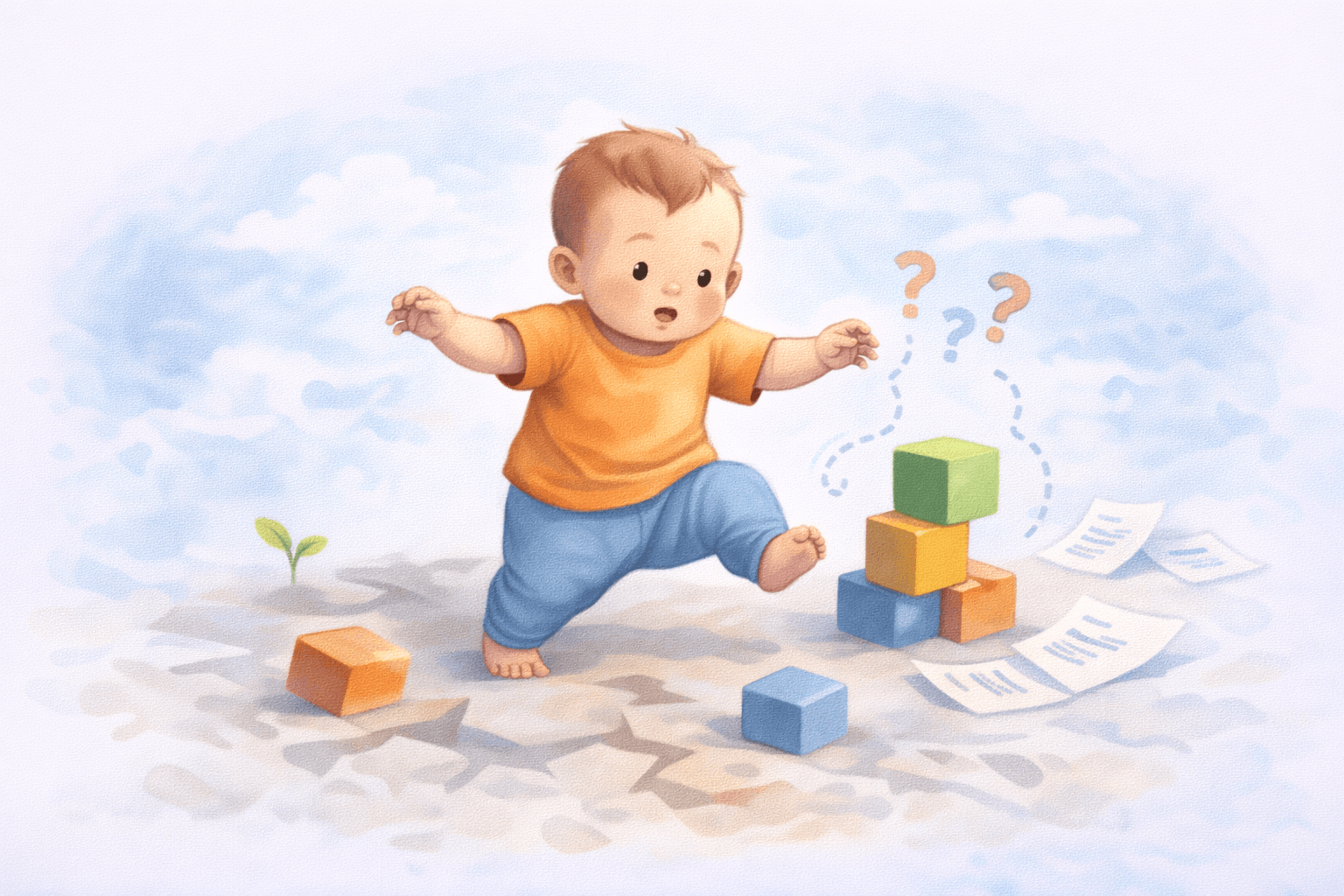
A Baby business is a business in its earliest functional stage. At this stage, the business is still forming its identity, learning how it operates, and discovering what works in its environment. Outcomes are unstable, clarity is limited, and progress often feels uneven—even when effort is consistent.
This page is for founders, operators, and teams who are experiencing uncertainty, inconsistency, or frequent change and want to understand whether those conditions are normal or indicative of a deeper problem. The purpose of this article is not to provide tactics or step-by-step guidance. Instead, it aims to explain what characterizes a Baby business and how decision-making tends to function at this stage of development.
Within the Business as a Baby (BAAB) framework, the term “Baby” is descriptive rather than evaluative. It does not imply weakness, lack of seriousness, or poor quality. It simply reflects a stage of formation where learning precedes stability and where development is still underway.
The Core Reality of a Baby Business
The defining reality of a Baby business is that it is still learning what it is. This learning occurs across multiple dimensions at once: product or service viability, customer behavior, operational capability, and decision-making patterns. Because these elements are still forming, outcomes are often unpredictable.
At this stage, effort and results are weakly correlated. Significant work may not immediately translate into consistent progress, while small changes can sometimes produce disproportionate effects. This can be disorienting, particularly for individuals accustomed to environments where effort and outcome are more directly linked.
Uncertainty is not a flaw in a Baby business; it is a structural feature. The business does not yet have enough information, repetition, or stability to behave predictably. Attempts to eliminate uncertainty prematurely often create additional strain rather than clarity.
From a BAAB perspective, instability at this stage is not something to be corrected. It is something to be understood.
Why We Accept Failure in Babies but Not in Businesses
In everyday life, babies are expected to fall while learning how to walk. Falling is not interpreted as failure, incompetence, or a sign that something is wrong. It is understood as part of the learning process. No one applies adult expectations to a child who is still developing coordination.
In business, however, early-stage instability is often treated differently. Missed targets, frequent changes in direction, or uneven progress are quickly interpreted as mistakes rather than signals of learning. The same behaviors that are accepted in early human development are judged harshly when they appear in early organizational development.
This difference in interpretation creates frustration. The issue is not that the business is falling. The issue is that adult expectations are being applied to something that has not yet learned how to stand.
For many founders, the difficulty lies in perception. In the moment, it can be hard to see the business as what it is: a system learning coordination. Instead, it is often viewed as something that should already function with stability and reliability. That mismatch between expectation and reality is what amplifies stress.
From a BAAB standpoint, reframing the business as a Baby does not excuse poor judgment or eliminate responsibility. It simply restores appropriate expectations for a system that is still developing.
What Actually Works at the Baby Stage (And Why)
At the Baby stage, what works best is not optimization, scale, or efficiency, but learning. The business is still gathering information about what is viable, what is sustainable, and what is worth building further. Decisions that support learning tend to create forward movement, even when outcomes remain uneven.
Flexibility matters more than structure at this stage because the business does not yet know which structures it will ultimately need. Overly rigid systems can lock in assumptions before they have been tested. In contrast, responsiveness allows the business to adjust as new information becomes available.
Speed is useful at the Baby stage, but not in the sense of rapid expansion. What matters is the speed of insight—how quickly the business can recognize what is and is not working, and adapt accordingly. Small experiments, limited commitments, and reversible decisions reduce the cost of being wrong while increasing the rate of learning.
Importantly, progress at this stage is often subtle. It may appear as improved understanding rather than visible growth. From a BAAB perspective, this kind of progress is not secondary; it is foundational. Businesses that invest time in understanding their own dynamics at the Baby stage are better positioned to stabilize later.
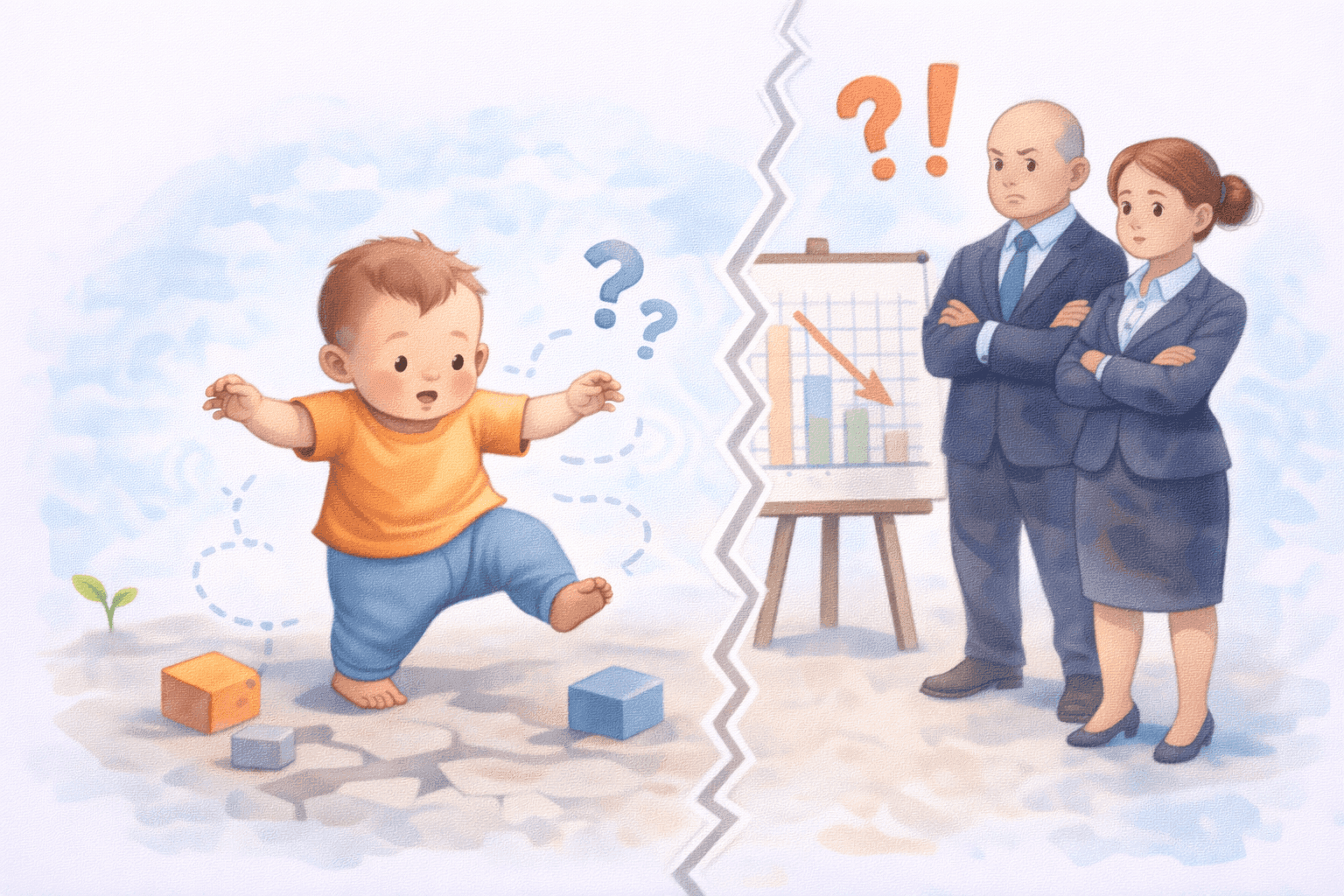
Illustration depicting the tension between early-stage learning and premature expectations
What Breaks Baby Businesses
Many Baby businesses encounter serious difficulty not because the underlying idea is flawed, but because decisions are made as if the business were already more mature than it is. These decisions are often driven by pressure—internal or external—to appear stable, credible, or successful.
One common source of strain is premature hiring. Bringing on additional people before roles are clear or work is repeatable can increase coordination costs and confusion. Instead of reducing workload, early hiring often amplifies complexity.
Another frequent issue is over-structuring. Processes, policies, and systems borrowed from mature organizations may look responsible, but they can restrict the flexibility that a Baby business needs to learn. When structure precedes understanding, it tends to preserve inefficiencies rather than eliminate them.
Copying playbooks designed for later-stage companies is another common pitfall. Advice that assumes stable demand, predictable operations, or clear market positioning can distort decision-making when those conditions are not yet present.
Finally, some Baby businesses break under the pressure to scale prematurely. Expansion is sometimes used as a way to relieve uncertainty or validate effort. When scaling occurs before the underlying model is understood, it often magnifies existing problems instead of resolving them.
From a BAAB perspective, these outcomes are not moral failures or signs of incompetence. They are predictable consequences of misaligned expectations and timing.
Hiring for a role like this right now? One call is usually enough for us to tell you whether we can fill it.
Book a CallBaby vs Other Stages (Context & Transitions)
The Baby stage is distinct from later stages not because it is smaller or less important, but because the nature of work and decision-making is fundamentally different. Comparing a Baby business to a more mature one without accounting for stage often leads to incorrect conclusions.
The primary difference between a Baby business and a Toddler business is repeatability. A Baby business is still discovering what works; a Toddler business has identified some patterns that can be repeated, even if they are not yet reliable or efficient. Consistency, not growth alone, is the key signal that a transition may be underway.
It is also common to misinterpret surface-level indicators as signs of transition. A temporary increase in revenue, a successful launch, or a period of heightened demand does not automatically mean a business has moved beyond the Baby stage. Transitions occur when learning stabilizes into patterns, not when outcomes spike briefly.
Rushing this transition can cause long-term damage. When a business is pushed to behave like a Toddler or Teenager before it has developed the underlying coordination, it often loses the flexibility that made learning possible in the first place. From a BAAB perspective, patience during the Baby stage is not passive—it is protective.
How TCE Thinks About Baby Businesses
At The Chum Effect, Baby businesses are approached with an emphasis on clarity rather than acceleration. The starting point is understanding the stage the business is actually in, not the stage it aspires to reach.
Rather than leading with execution, hiring, or scale, the focus is placed on decision context. At the Baby stage, forcing action too early often reduces optionality and increases risk. In many cases, restraint preserves more value than speed.
Guidance at this stage tends to prioritize interpretation over instruction. The goal is not to impose structure, but to help leaders recognize which pressures are structural and which are self-imposed. This distinction allows decisions to be made with greater alignment to reality rather than urgency.
This approach does not slow progress. It reduces unnecessary damage and increases the likelihood that when the business does move forward, it does so with a clearer foundation.
Closing Perspective
Early-stage uncertainty often feels personal, especially when time, identity, and resources are involved. From a BAAB perspective, much of that uncertainty is structural rather than individual.
A Baby business is not expected to provide stability before it has learned how to create it. Support systems precede independence, learning precedes optimization, and clarity precedes growth. Recognizing this order does not eliminate difficulty, but it does make the experience easier to interpret—and therefore easier to navigate.
Frequently Asked Questions

Is it normal if nothing feels stable yet?
Yes. Instability is a defining characteristic of the Baby stage. The absence of consistency does not imply failure; it reflects that the business is still learning how its components interact.
How long does the Baby stage usually last?
There is no fixed duration. Some businesses move through this stage quickly, while others remain in it for years. Progress depends on learning and stabilization rather than time alone.
Should I quit my job to focus on a Baby-stage business?
This is less a question of commitment and more a question of support. At the Baby stage, the business is the dependent, not the provider. Quitting a job may make sense if there is a clear and sustainable support system in place, but expecting the business itself to provide that support prematurely often creates unnecessary pressure. Support systems vary widely and may include employment income, spousal support, savings, loans, grants, venture funding, family resources, trust funds, or internal budgets within larger organizations. The form of support matters less than clarity about what is supporting what.
Should I take out a loan at this stage?
Loans can function as a support mechanism, but they also introduce fixed obligations. At the Baby stage, where outcomes are uncertain, adding rigidity can increase risk. The key consideration is whether the loan supports learning or forces premature performance.
Is raising venture capital appropriate for a Baby business?
Venture capital can provide resources, but it also introduces expectations around growth and timelines. For some Baby businesses, this alignment makes sense; for others, it creates pressure to behave like a later-stage company before the foundation is ready.
What if revenue is inconsistent or unpredictable?
Inconsistency is common at this stage. Revenue volatility often reflects ongoing learning rather than a broken model. The question is whether insights are accumulating alongside the volatility
Can a business stay in the Baby stage for years?
Yes. Remaining in the Baby stage is not inherently negative. Problems arise when expectations or obligations assume maturity that the business has not yet developed.
How do I know when I’m no longer in the Baby stage?
The transition usually becomes visible when outcomes begin to repeat reliably and decision-making shifts from exploration to refinement. Stability, not scale alone, is the primary signal.
Where Baby Fits in the BAAB Framework
Within the BAAB framework, the Baby stage represents the foundation of all later development. What is learned here shapes how the business behaves as it grows. To understand how this stage connects to the broader framework, you can revisit the Business as a Baby (BAAB) Overview, or continue forward to explore what changes when a business begins to stabilize in the Toddler stage.
Hiring right now? Let's talk.
Book a 20-minute call with The Chum Effect. Bring the role you are struggling to fill and we will tell you honestly whether we can help, including when we are not the right fit.
Related articles
Why Businesses Stall After Their First Breakthrough ?
Why Advice From Successful Founders Often Fails Early Startups
You did everything they said. You watched the interviews. You read the threads. You followed the playbooks. #### And yet, nothing is working.
Why Your Business Can’t Support Your Life Yet
Working hard doesn’t mean your business can carry your life yet. This piece explains why that gap is normal—and how to protect both yourself and the business.
Why Going All In Is Not the Same as Being Serious
Going all in feels brave, but early businesses need protection, not pressure. Seriousness is about staying long enough to learn.
The Everyday Thinking Partner Rule
A simple rule for using AI without losing your judgment: let it clarify your thinking, not decide for you. Clearer mind. Same responsibility.
Why Trust Is the Only Real Hiring Asset
Interviews, data, and tools can look perfect on paper. This piece explains why trust is what actually holds hiring systems together.


