


AI as a thinking Partner - People Edition
February 3, 2026 • 14 mins read
Quick Answer
Clarity improves when thinking is externalized. A thinking partner helps by reflecting your reasoning back in a structured way so assumptions, gaps, and relationships become visible. AI can serve this role well—organizing messy thoughts and translating complexity into plain language—while judgment and responsibility remain yours.

By Chukwudum “Chumze” Chukwudebelu
Founder/CEO, TheChumEffect Creator of the BAAB Framework

How People Actually Think
Most people assume that thinking is a clean, orderly process.
It isn’t.
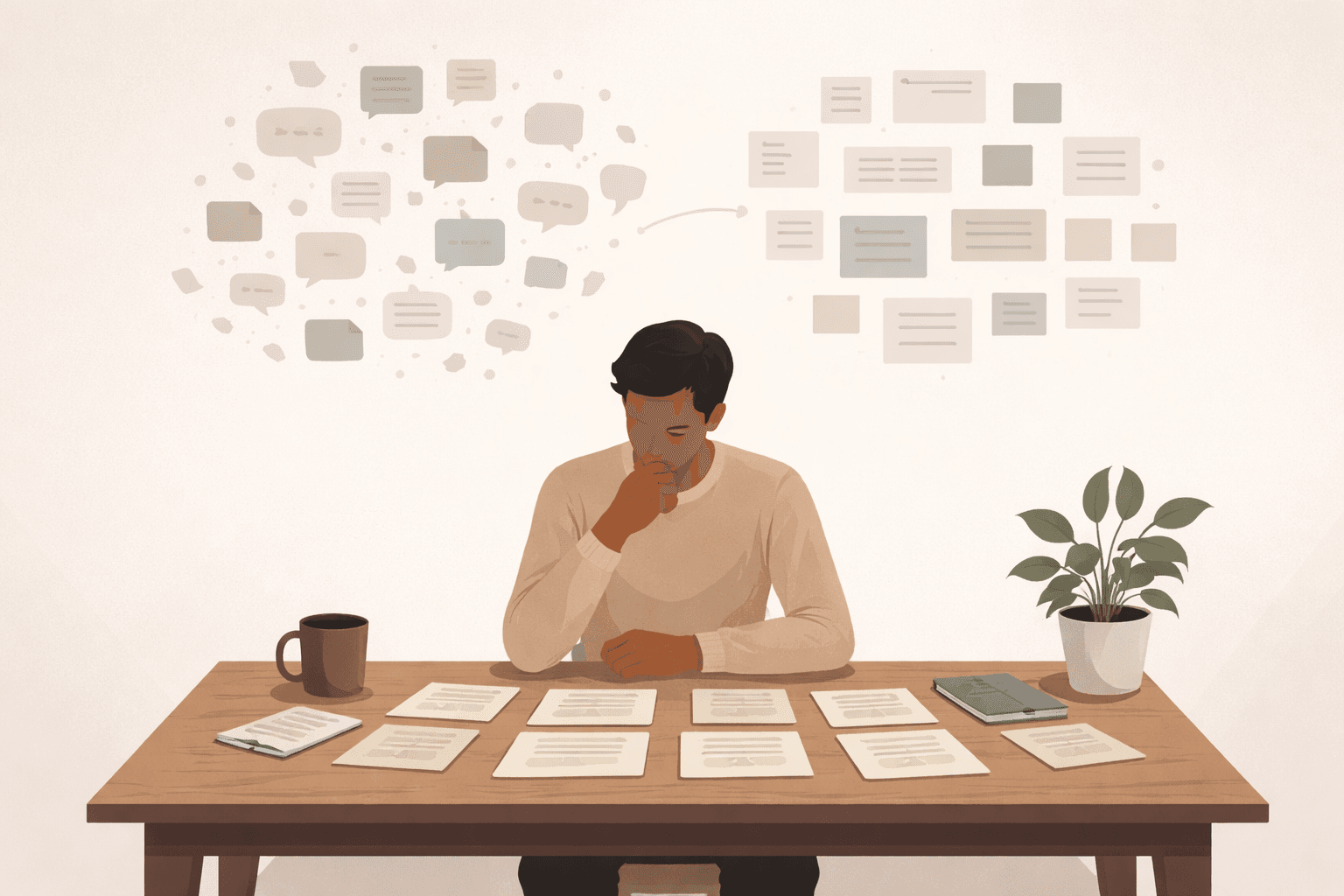
Thinking is often fragmented, nonlinear, and unfinished. Ideas arrive in pieces. Concerns overlap. One thought interrupts another. Context shifts as new information appears.
This is normal.
People don’t think in complete systems. They think in partial impressions—signals, intuitions, fragments of reasoning that only make sense once they’re connected.
The problem isn’t that people don’t think enough.
It’s that they think internally, where everything competes for attention at the same time.
When thinking stays internal:
- important details get buried
- assumptions go unexamined
- conclusions form before understanding is complete
This creates a familiar feeling:
“I’ve thought about this, but I still don’t feel clear.”
That feeling is not confusion.
It’s unstructured thinking.
Clarity doesn’t come from trying harder to think.
It comes from making thinking visible.
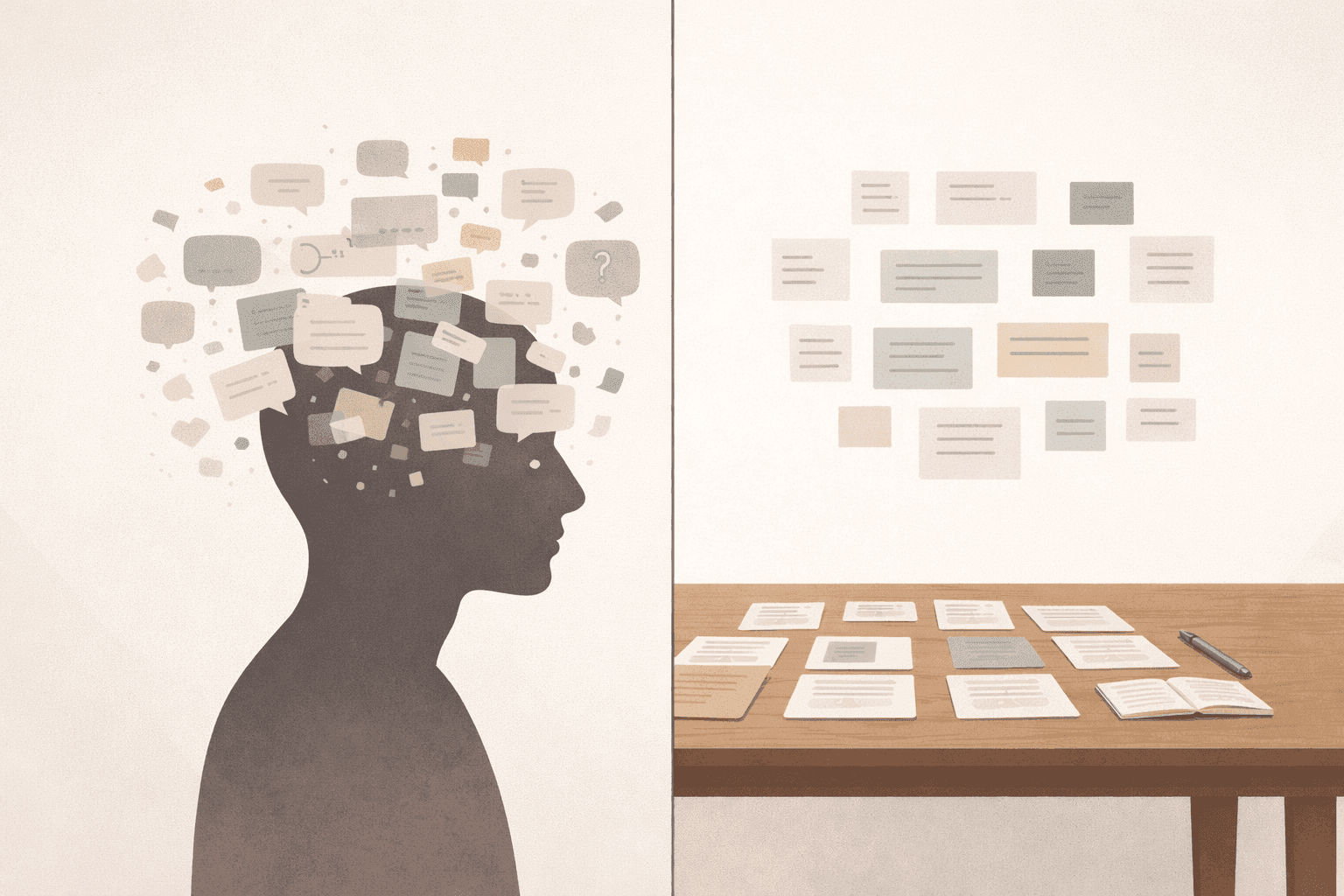
A split illustration showing a cluttered mind filled with overlapping thoughts on one side and neatly organized notes laid out on a desk on the other, representing internal thinking versus externalized clarity.
The Difference Between Thinking and Understanding
Thinking and understanding are not the same thing.
Thinking happens automatically. It’s reactive. It jumps ahead.
Understanding is deliberate. It requires pause, structure, and reflection.
Many people confuse repetition with progress. They revisit the same thoughts again and again, hoping clarity will eventually emerge. Instead, the loop continues.
Not because the answer is missing—but because the connections aren’t visible.
Understanding happens when:
- ideas are laid out clearly
- assumptions are exposed
- relationships between pieces become obvious
This rarely happens in the mind alone.
When thoughts are externalized, something changes.
They slow down. They can be examined. They can be rearranged.
This is the moment where understanding begins to form—not because new information appeared, but because existing information finally made sense together.
Understanding is not about certainty.
It’s about seeing the situation clearly enough to choose deliberately
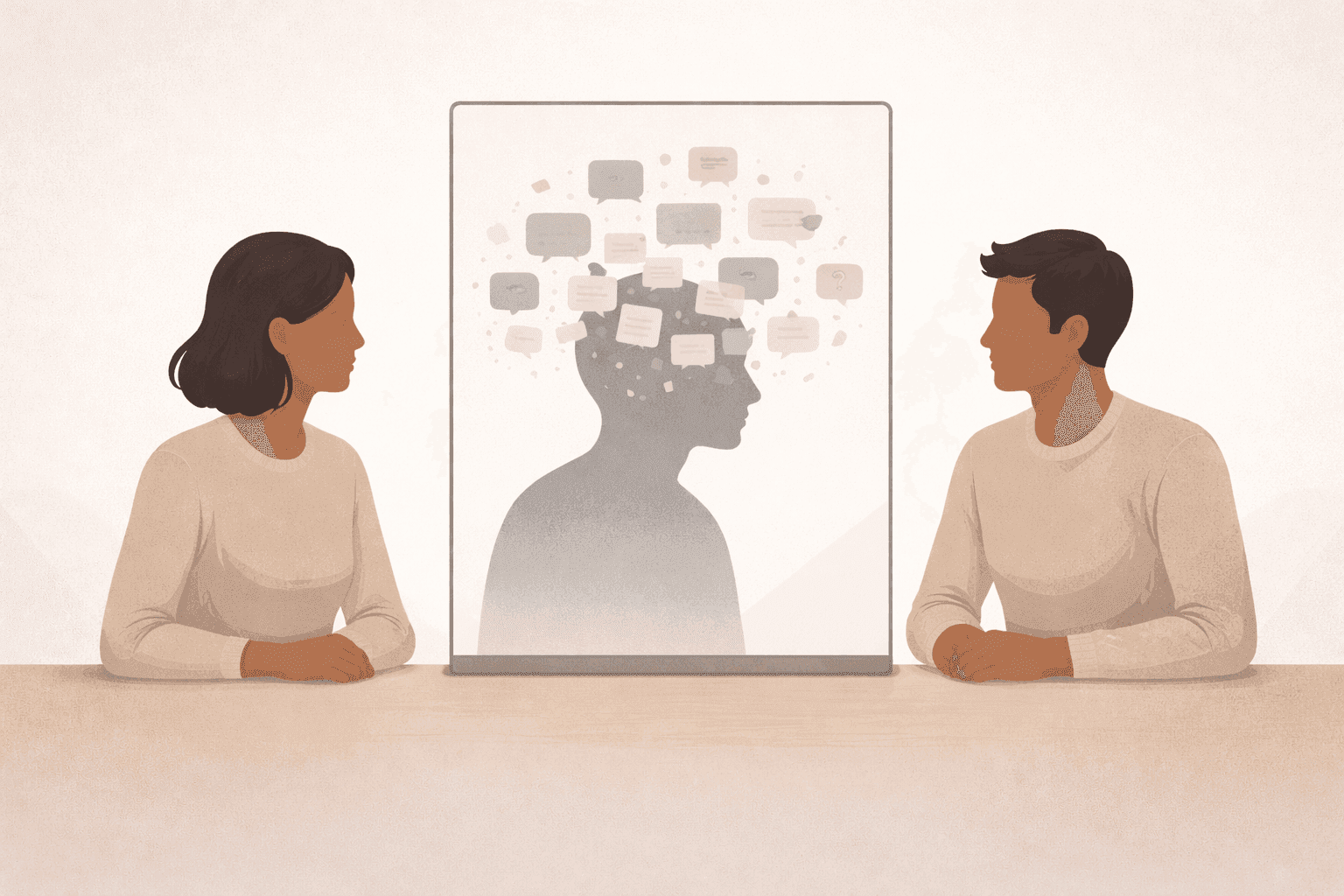
A mirror reflecting a person’s thoughts as two people sit across from each other, symbolizing a thinking partner that reflects reasoning rather than directing decisions.
What a Thinking Partner Actually Is
A thinking partner is not someone who tells you what to do.
And it’s not something that replaces your judgment.
A thinking partner helps you hear your own thinking more clearly.
Most people already use thinking partners in everyday life without calling them that. It’s what happens when you talk something out, not to be persuaded, but to understand what you’re actually thinking.
The value isn’t in the answer.
It’s in the reflection.
When your thoughts are reflected back to you—clearly, without interruption or bias—you start to notice things you missed:
- assumptions you didn’t realize you were making
- gaps in your reasoning
- ideas that sounded right internally but don’t hold up externally
A thinking partner doesn’t push you in a direction.
It slows things down just enough for clarity to emerge.
This is important: a thinking partner does not remove responsibility.
You still decide. You still act. You still own the outcome.
What changes is that you’re no longer deciding in a mental fog.
A good thinking partner creates space—space to examine, question, and refine your thinking before you commit to a choice.
That’s it.
Nothing more. Nothing mystical.
Just clearer thinking.
Why People Have Always Used Thinking Partners
Most people do not realize they already use thinking partners because they do not label the behavior.
It usually begins with a moment of friction. Someone is reading, reviewing, or considering something and feels a subtle pause. They understand what they are looking at, but not completely. Something feels unfinished.
So they stop.
They might reread the material. Then they reach out to someone else, not because they skipped the work, but because they want to confirm what it actually means. They explain the situation out loud and walk through how they are interpreting it.
As they speak, clarity often starts to form. Sometimes it comes from the response. Other times it comes from hearing their own reasoning reflected back to them.
That moment of recognition is familiar. Things either click, or they clearly do not.
The same pattern appears when people are thinking through a decision. They are not asking to be told what to do. They are checking whether their reasoning still makes sense once it leaves their head and becomes explicit.
Most clarity does not arrive as new information. It arrives when existing information is interpreted correctly and placed in the right context.
This is why people naturally reach for someone to help interpret what they have already read, to talk through a move they are already considering, or to reflect their reasoning back without judgment.
This behavior is not formal or specialized. It is instinctive.
People do this because they trust their own judgment, but they also understand that blind spots exist. A thinking partner helps surface those blind spots before they turn into consequences.
AI fits into this pattern not as a replacement for human judgment, but as a tool that allows this kind of reflection to happen on demand. It removes social friction and timing constraints, making it easier for people to think clearly when they need to.
Once people recognize this pattern in their own life, the idea no longer feels new. It feels familiar.
They realize they have been doing this all along.
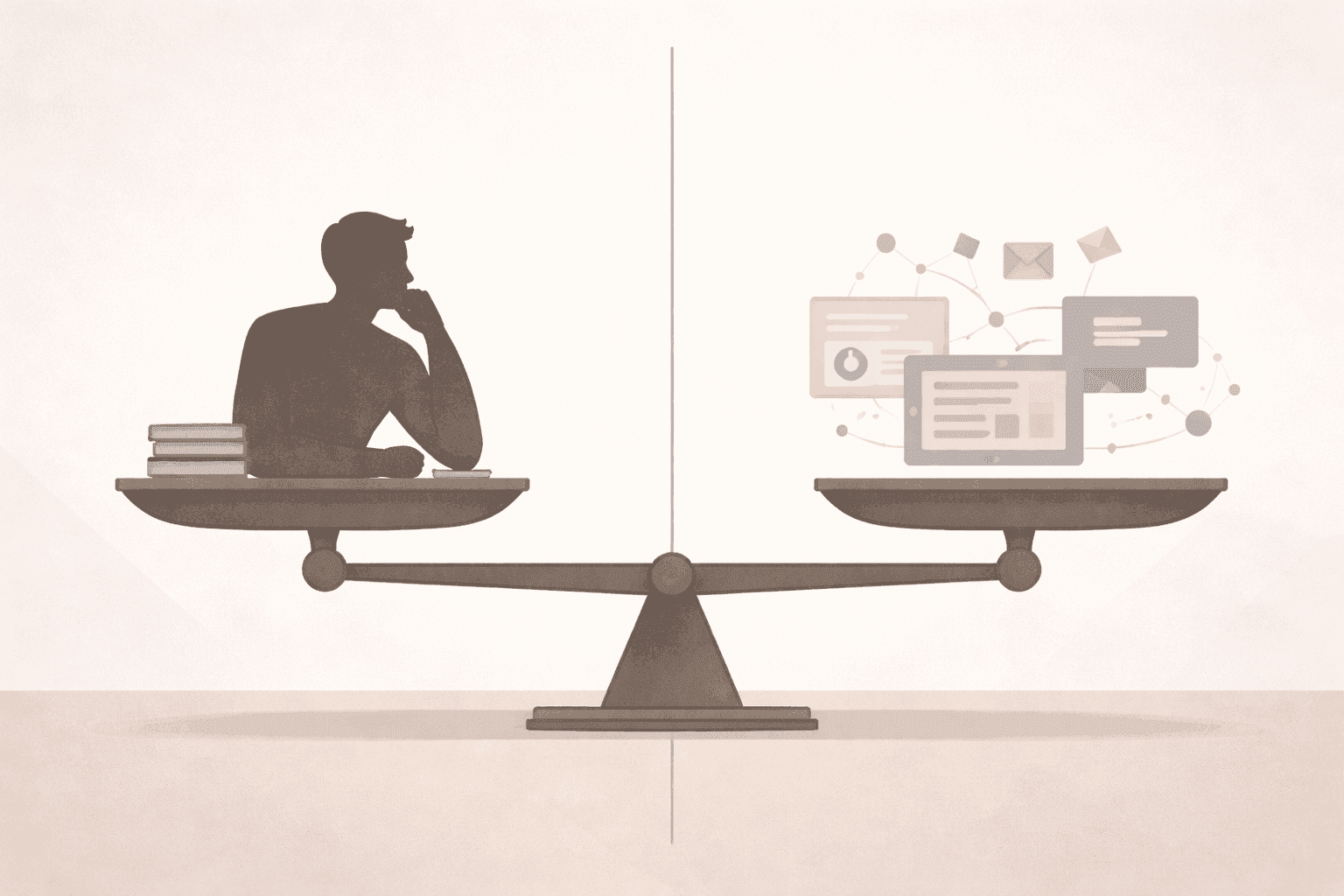
A balanced scale showing a thoughtful human on one side and AI tools on the other, illustrating AI as support for clarity while judgment and responsibility remain human.
Where AI Fits and Where It Does Not
AI fits best where clarity is needed, not where judgment must be outsourced.
Its role is to support reflection, not to replace decision-making. It helps organize thoughts, surface patterns, and reflect reasoning back in a way that makes blind spots easier to see. It does not decide what matters. It does not choose what to do. It does not carry consequences.
That responsibility remains human.
AI is useful when someone wants to slow their thinking down, examine it from different angles, or make sense of complexity without pressure. It is especially effective when thoughts are messy, incomplete, or still forming and need structure before a decision is made.
Where AI does not belong is in the seat of authority.
It should not be treated as a source of truth, a final arbiter, or a substitute for accountability. Fluency is not wisdom, and articulation is not judgment. Clear language can still describe flawed reasoning if the underlying assumptions are wrong.
AI reflects what it is given. If the context is incomplete or distorted, the output will be as well. That is not a flaw in the tool. It is a reminder of where responsibility lies.
Used correctly, AI strengthens thinking by making it visible and easier to examine. Used incorrectly, it weakens thinking by encouraging deferral instead of ownership.
The distinction is simple.
AI supports understanding.
People remain responsible for decisions.
That boundary is what makes AI useful rather than dangerous.
Thinking Integrity and Honest Context
AI can only work with what it is given.
That makes honesty a practical requirement, not a moral one.
Thinking integrity means giving context as it actually exists, not as you wish it were or as you want it to appear. When the input is selective, softened, or incomplete, the reflection will be distorted. The result may still sound coherent, but it will not be accurate.
This is why clarity sometimes feels elusive even after using powerful tools. The issue is not intelligence or effort. It is misalignment between reality and the way it is being described.
One of the advantages of using AI as a thinking partner is the absence of social pressure. There is no audience to impress and no reputation to protect. That makes it easier to state things plainly, including uncertainty, doubt, or contradictions that might be uncomfortable to voice elsewhere.
Honest context allows patterns to emerge. It reveals tradeoffs, constraints, and assumptions that were previously hidden. Without that honesty, reflection becomes performance rather than understanding.
Thinking integrity does not require perfect articulation. It requires truthful articulation. Messy, incomplete thoughts are not a problem. Misleading ones are.
When the goal is clarity, honesty becomes the shortest path.
Asking AI to Think With You
Using AI as a thinking partner does not require special prompts or carefully engineered language. It does not require you to know exactly what you are asking for.
In most cases, clarity comes from starting where you actually are.
That means speaking in incomplete thoughts, loose ideas, and rough context. It means explaining the situation the way you would if you were talking it through out loud, not the way you think it is supposed to sound.
You do not need to frame the problem perfectly. You do not need to arrive with a polished question. What matters is giving enough context for the situation to be understood as a whole.
This is often as simple as saying what you know so far, what you are unsure about, and what feels unresolved. From there, AI can help organize the pieces, surface inconsistencies, and reflect your thinking back in a clearer form.
The value is not in receiving an answer.
It is in seeing your own reasoning laid out in front of you.
When used this way, AI becomes a space to explore ideas without pressure. You can refine your thinking, challenge assumptions, and iterate without committing prematurely to a conclusion.
The goal is not speed.
The goal is understanding.
When you reach that point, decisions tend to feel calmer and more deliberate because they are grounded in clarity rather than urgency.
Hiring for a role like this right now? One call is usually enough for us to tell you whether we can fill it.
Book a CallBreaking Things Down in Plain Language
Clarity does not come from complexity.
It comes from understanding.
One of the most useful ways to work with AI as a thinking partner is to ask it to slow things down and explain ideas in simple terms. This is not about lowering standards or avoiding nuance. It is about making sure understanding exists before conclusions are drawn.
When something feels unclear, it is often because the language surrounding it is dense, abstract, or layered with assumptions. Breaking it down removes that friction.
This can mean asking for an explanation in everyday language, requesting that ideas be separated into their basic components, or exploring what something means in practical terms rather than theoretical ones.
The goal is not to sound intelligent.
The goal is to actually understand.
When ideas are explained plainly, gaps become visible. You can see what you know, what you do not know, and where further thinking is required. This prevents false confidence and reduces the risk of acting on misunderstood information.
Understanding something well enough to explain it simply is often the difference between reacting and deciding.
AI helps by translating complexity into clarity, allowing people to engage with ideas at the level they need, without intimidation or unnecessary friction.

A calm illustration showing a continuous loop between reflection and action, with moments of thinking, working, and revisiting notes, representing reflection before, during, and after action.
Reflection Before, During, and After Action
Reflection does not require stopping life or delaying action.
It can happen before a decision, while something is already in motion, or after an outcome has occurred.
Many people assume that thinking must come first and action must wait. In reality, most decisions unfold in stages. People act with the information they have, learn from what happens, and adjust as new understanding emerges.
Reflection fits naturally into this process.
Sometimes it happens before action, when you are trying to understand a situation clearly enough to choose a direction. Other times it happens during action, when new information appears and assumptions need to be revisited. It can also happen after action, when you look back to understand what worked, what did not, and why.
Using AI as a thinking partner does not mean pausing everything until clarity is perfect. It means creating space to reflect when reflection is useful.
You can act, then return to reflection.
You can reflect briefly, then move forward.
You can revisit decisions as context changes.
This flexibility matters because real life does not wait for perfect understanding. Reflection is most effective when it supports momentum rather than replaces it.
The value is not timing.
The value is awareness.
When reflection becomes part of the process instead of a separate event, decisions improve naturally over time.
AI Is a Mirror, Not Judgment
AI does not judge.
It reflects.
It takes the information, context, and reasoning you provide and mirrors it back in a structured form. That reflection can reveal patterns, gaps, or inconsistencies that are difficult to see internally.
What AI does not do is decide what matters.
It does not understand consequences.
It does not carry responsibility.
It does not live with outcomes.
This distinction is critical.
Because AI can speak fluently and organize ideas clearly, it is easy to mistake articulation for authority. Clear language can give the illusion of correctness even when the underlying reasoning is flawed.
That is why judgment must remain human.
AI can help you see your thinking more clearly, but it cannot tell you whether a choice is right for your situation. It can highlight tradeoffs, but it cannot weigh them according to your values, priorities, or tolerance for risk.
Used correctly, AI sharpens judgment by making reasoning visible.
Used incorrectly, it weakens judgment by encouraging deferral.
The tool is powerful because it mirrors what is already there.
What you do with that mirror is your responsibility.
Where People Go Wrong
Most problems with using AI as a thinking partner do not come from the tool itself.
They come from how it is positioned in the thinking process.
One common mistake is treating AI as an authority rather than a mirror. When people defer judgment to the output instead of examining it, responsibility quietly shifts away from where it belongs. The result may feel decisive, but it is often disconnected from reality.
Another mistake is using AI to avoid action rather than to support it. Reflection becomes an endless loop, not because clarity is impossible, but because commitment is being postponed. Thinking without movement eventually turns into stagnation.
Some people also rely on AI to confirm what they already want to believe. When context is selectively framed or opposing considerations are ignored, the reflection becomes an echo rather than an examination. This can create confidence without understanding.
Finally, there is the mistake of assuming better articulation means better thinking. Clear language can make weak reasoning sound solid. Without judgment, fluency becomes misleading.
None of these issues are about misuse in a moral sense. They are structural errors in how responsibility is assigned.
AI works best when it supports thinking, not when it replaces it.
Clarity improves when reflection leads to deliberate choice, not when it delays it.
When responsibility stays human, the tool remains useful.
The Everyday Thinking Partner Mandate
AI does not change what it means to make a decision.
It changes how clearly you can see what you are deciding.
In everyday life, judgment still belongs to the person living with the outcome. No tool can assume that responsibility. No reflection, no matter how clear, removes the need to choose.
What AI offers is not certainty.
It offers visibility.
When thinking is externalized, it can be examined. When it can be examined, it can be refined. When it is refined, decisions tend to feel calmer, more deliberate, and less reactive.
This is the mandate.
Use AI to clarify, not to avoid.
Use it to reflect, not to defer.
Use it to understand, not to replace judgment.
There is no requirement to use AI before acting, and no rule that reflection must be perfect. Thinking can happen before, during, or after action. What matters is that responsibility remains intact.
AI does not make people wiser.
It makes their thinking easier to see.
What people do with that visibility is what ultimately matters.
Clarity does not remove choice.
It strengthens it.
That is where AI fits in everyday life.
Frequently Asked Questions

What does “AI as a thinking partner” actually mean?
It means using AI to help you organize, reflect on, and clarify your thinking, not to decide for you or replace your judgment.
Is this about using AI to tell me what to do?
No. AI does not make decisions. It reflects your thinking back to you so you can understand it more clearly and make your own choices.
Do I need to be good with technology to use AI this way?
No. You do not need technical skills, special prompts, or structured language. You can speak naturally and start from wherever your thinking currently is.
What kinds of situations can I use this for?
Any situation where clarity matters. If you are thinking seriously about something and want to understand it better before acting, AI can support reflection.
Do I need to use AI before taking action?
No. Reflection can happen before, during, or after action. AI supports thinking, not timing.
Is this the same as asking AI for advice?
No. Advice tells you what to do. A thinking partner helps you understand what you are deciding.
Can AI replace talking things through with people?
No. AI does not replace people. It complements reflection by reducing social friction and availability constraints.
What if my thoughts are messy or incomplete?
That’s fine. Thoughts do not need to be polished or complete to be examined. You can start wherever your thinking currently is. Whether your ideas are clear, fragmented, or still forming, AI can help reflect them back in a way that makes them easier to see and understand. What matters is not how refined your thoughts are, but whether the context you provide is honest.
Do I need to phrase things a certain way for AI to work?
No. Context matters more than wording. You can speak plainly, imperfectly, and naturally.
What is “thinking integrity”?
Thinking integrity means being honest about your situation when you give context. AI reflects what it is given, so clarity depends on accuracy and honesty.
Can AI help me understand things in simple terms?
Yes. You can ask AI to break things down, explain them plainly, or translate complexity into practical understanding.
Is using AI this way avoiding responsibility?
No. Responsibility always stays with you. AI supports understanding, not accountability.
Can AI be wrong?
Yes. AI reflects patterns and language, not truth or judgment. Outputs should always be examined critically.
What happens if I rely on AI too much?
When AI replaces judgment instead of supporting it, clarity weakens. The tool works best when responsibility remains human.
Is this meant to be used constantly?
No. Use AI when reflection is useful. Thinking partners support moments that matter, not every moment.
Does AI make people smarter?
No. It makes thinking more visible. What you do with that visibility determines the outcome.
What’s the main benefit of using AI this way?
Clarity. You understand what you are thinking, why you are thinking it, and what you are choosing.
What’s the biggest mistake people make with AI?
Treating fluency as authority and deferring judgment instead of examining it.
Is AI judgment-free?
Yes. That is one of its advantages. It allows honest reflection without social pressure.
What’s the core rule to remember?
AI helps you think. You decide.
Hiring right now? Let's talk.
Book a 20-minute call with The Chum Effect. Bring the role you are struggling to fill and we will tell you honestly whether we can help, including when we are not the right fit.
Related articles
Business as a Baby (BAAB): A Stage-Based Way to Understand How Businesses Actually Grow
Toddler Businesses: Navigating Early Self-Sufficiency Without Losing Balance
Teenager Businesses: Power Without Governance
Staffing: Hiring Without Breaking the Business
Why Trust Is the Only Real Hiring Asset
Interviews, data, and tools can look perfect on paper. This piece explains why trust is what actually holds hiring systems together.
The Everyday Thinking Partner Rule
A simple rule for using AI without losing your judgment: let it clarify your thinking, not decide for you. Clearer mind. Same responsibility.


