


AI as a Thinking Partner - Business Edition
February 3, 2026 • 18 mins read
Quick Answer
AI is most useful when it improves thinking, not when it accelerates execution. As a thinking partner, it helps leaders externalize reasoning, surface assumptions, explore alternatives, and see tradeoffs more clearly—while judgment and accountability remain human.

By Chukwudum “Chumze” Chukwudebelu
Founder/CEO, TheChumEffect Creator of the BAAB Framework


The Problem AI Was Originally Adopted to Solve Drag
AI adoption did not start in the wrong place.
It started in the most obvious place.
For most individuals and organizations, AI was first used to support tasks that were:
- repetitive
- time-consuming
- execution-heavy
- low-risk
Drafting content, summarizing information, organizing ideas, generating options—these were practical entry points. They delivered immediate value and reduced friction in daily work.
This usage was not shallow. It was appropriate.
The confusion emerged not from how AI was first used, but from how its role was later interpreted.
Productivity gains were often mistaken for improved thinking. Increased output was confused with better judgment. Speed became a proxy for clarity.
AI did what it was designed to do. The gap appeared at the level of scope.
As problems became more complex—cross-functional, high-stakes, and ambiguous—the limitation was no longer execution capacity. It was thinking quality under complexity.
AI was adopted to make work easier.
The challenge leaders face now is making decisions better.
Thinking vs Execution: Where Decisions Actually Break
Most visible failures in business look like execution failures.
Projects miss deadlines.
Strategies stall.
Teams misalign.
Initiatives underperform.
The instinctive response is to work harder, move faster, or add more resources.
In reality, many execution problems are downstream symptoms of upstream thinking failures.
These failures often originate from:
- poorly framed problems
- unexamined assumptions
- compressed decision timelines
- emotional attachment to prior choices
- cognitive overload
As organizations grow, leaders are required to process more variables with less time and less reliable information. Decisions become layered, interconnected, and politically constrained.
Speed increases. Reflection decreases.
Execution amplifies whatever decisions are made upstream. When thinking is clear, execution compounds value. When thinking is flawed, execution compounds error.
This is why experience alone is not enough.
Experience provides pattern recognition, but it can also lock leaders into familiar frames. Under pressure, even seasoned decision-makers default to shortcuts, intuition, or prior success models that may no longer apply.
The challenge is not effort.
It is maintaining thinking quality as complexity increases.
This is the gap a true thinking partner addresses—not by executing faster, but by slowing down thinking at the right moments, forcing clarity before action, and making reasoning visible before decisions are amplified.
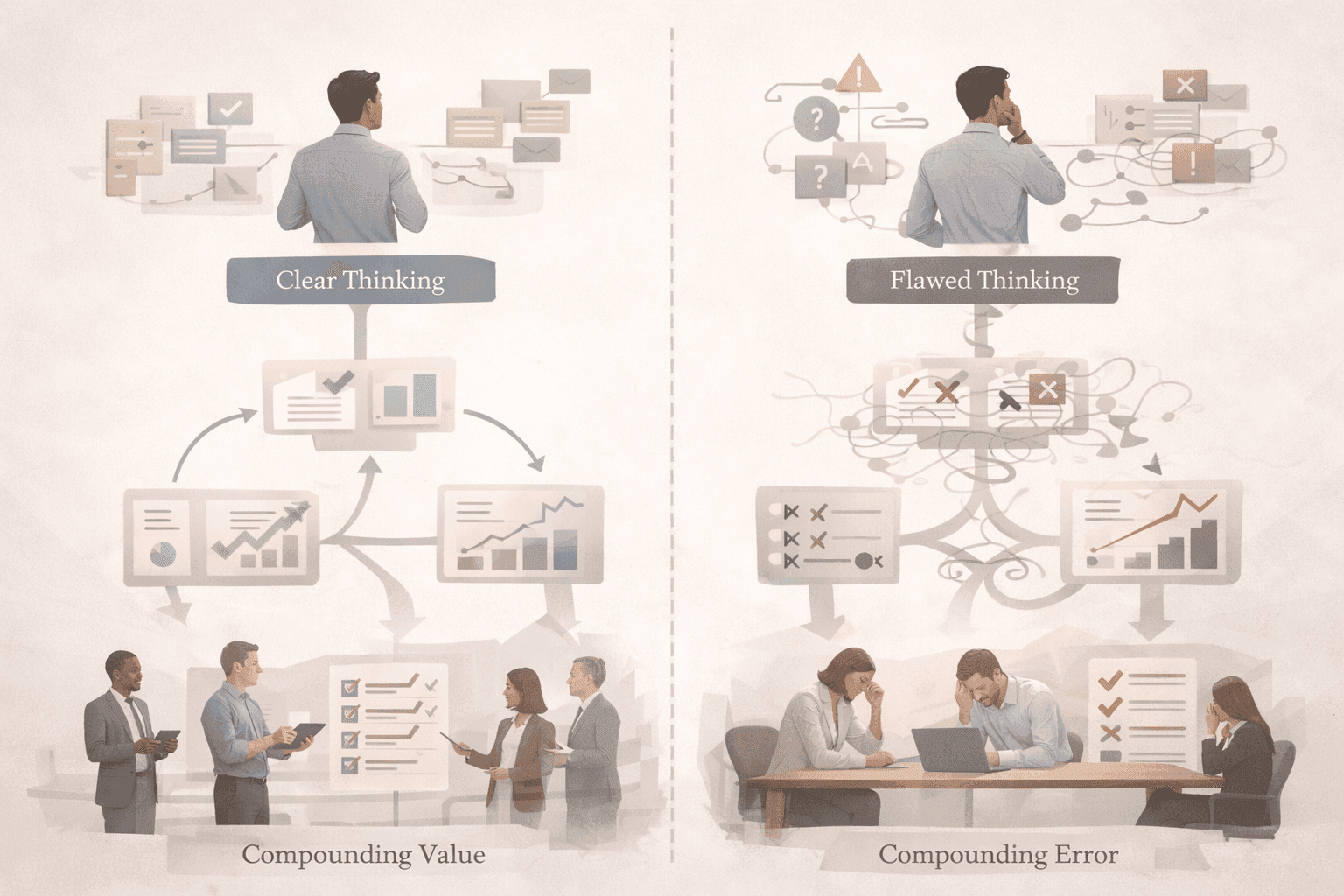
A side-by-side illustration showing clear upstream thinking leading to smooth execution and compounding value on one side, and flawed upstream thinking leading to chaotic execution and compounding error on the other.
What “Thinking Partner” Actually Means
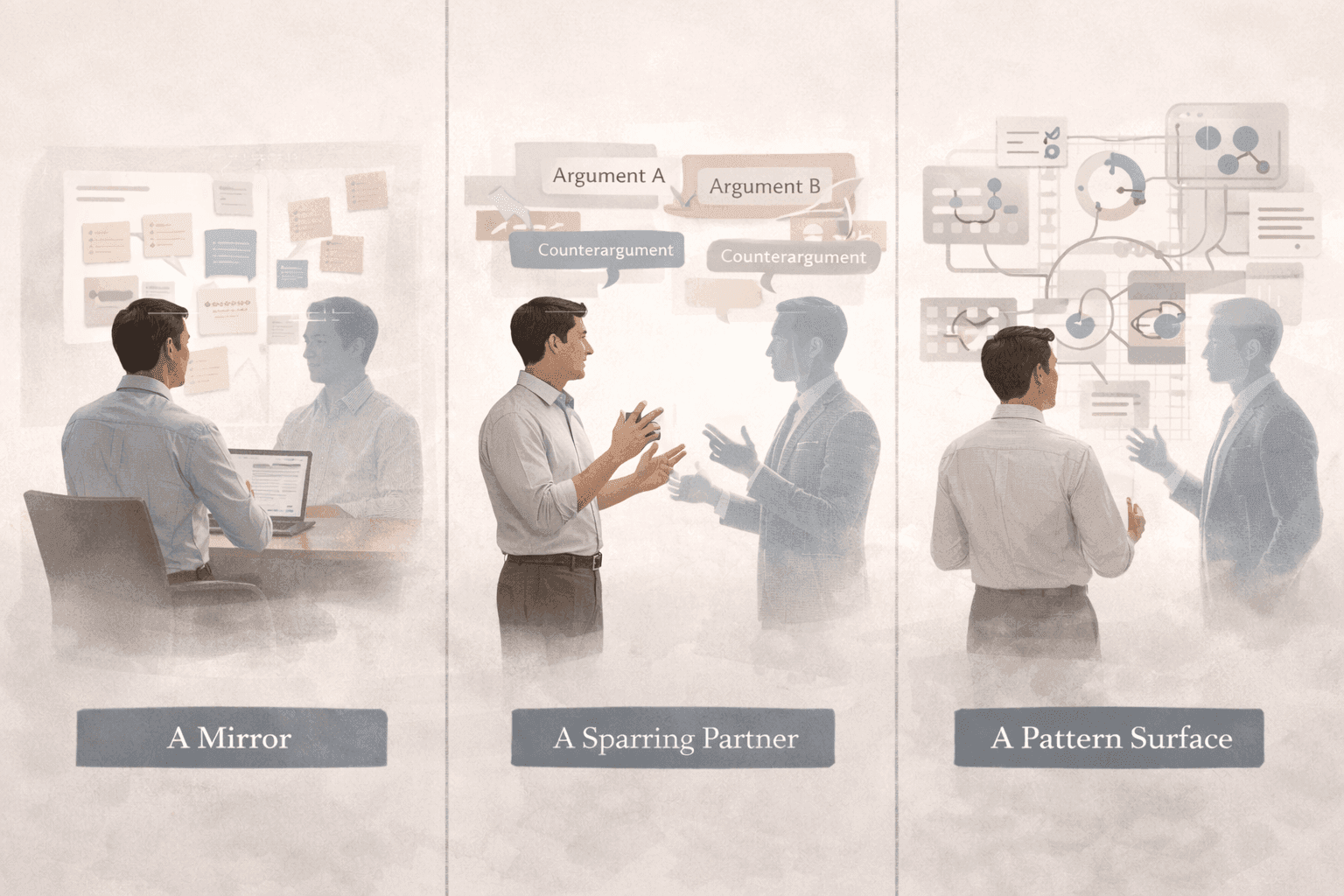
A three-panel illustration showing AI as a mirror reflecting thoughts, a sparring partner challenging reasoning, and a pattern surface revealing relationships, illustrating the roles of a thinking partner in decision-making.
A thinking partner is not a source of answers.
It is a mechanism for clearer thinking.
The term is often misunderstood because it sounds abstract. In practice, a thinking partner serves a very specific function: it helps externalize reasoning so it can be examined, challenged, and refined before and after action.
Used properly, AI does not replace judgment.
It supports the act of judgment.
As a thinking partner, AI functions in three primary ways.
A Mirror
AI reflects assumptions back to the user.
When thoughts are expressed—even in raw, unstructured form—patterns begin to surface. Inconsistencies become visible. Repeated themes and hidden beliefs are exposed simply by seeing one’s own reasoning articulated externally.
This does not require carefully framed prompts. Most real decisions do not begin clearly formed. They begin as fragments—partial thoughts, tensions, intuition, and contradiction. AI can absorb this context and help clarify what is already present but not yet articulated.
A Sparring Partner
AI can challenge lines of thought without ego, politics, or fatigue.
It can ask for clarification, explore counterarguments, and test reasoning under alternative assumptions. This allows leaders to pressure-test ideas privately, without social cost, before exposing them to teams or boards.
The value here is not correctness. It is friction without consequence.
A Pattern Surface
AI helps hold and compare multiple possibilities simultaneously.
It can explore parallel scenarios, highlight tradeoffs, and surface relationships that would be difficult to maintain mentally at scale. This expands the thinking surface area without increasing cognitive load.
Reflection, Action, and Refinement
Execution still matters. Action creates real-world feedback that no amount of reflection can replace.
But execution without reflection leads to momentum without direction.
AI adds value when it supports reflective thinking around action—helping leaders step back, interpret what happened, separate signal from noise, and adjust direction. It is most effective when used intentionally, not as a constant companion during execution itself.
As clarity begins to emerge, AI can also be used for refinement. Once a direction or goal becomes visible, leaders may ask AI to help formalize questions, suggest alternative framings, or even generate prompts aligned with what they are ultimately trying to accomplish.
This refinement phase is downstream of understanding, not a prerequisite for it.
What a Thinking Partner Does Not Do
A thinking partner does not:
- make decisions
- assign responsibility
- determine values
- replace intuition
- remove accountability
Those remain human functions.
AI can help clarify what is being decided and why, but the responsibility for deciding—and living with the consequences—never moves.
The Distinction That Matters
Execution tools optimize output.
Thinking partners optimize reasoning within the decision loop.
AI does not make decisions better by moving faster.
It makes decisions better by making thinking visible.
Why Leaders Struggle to Think Clearly at Scale

A business leader surrounded by distorted and conflicting information in a busy organization, illustrating how clarity breaks down as decisions scale and signals become noisy.
As organizations grow, thinking does not get harder because leaders become less capable.
It gets harder because the environment around decisions changes.
At scale, leaders are rarely short on information. They are surrounded by it. What becomes scarce is clean signal.
Several forces begin to distort thinking simultaneously.
Decision Compression
As responsibility increases, decisions accumulate faster than reflection time.
What used to be a single, contained choice becomes a chain of interdependent decisions—each one influencing multiple teams, incentives, and outcomes. Leaders are forced to decide with partial visibility, often under time pressure, knowing that inaction is itself a decision.
Reflection gets postponed. Momentum takes over.
Information Distortion
At scale, information rarely travels neutrally.
Data is filtered through:
- incentives
- fear
- internal politics
- hierarchy
- optimism or defensiveness
By the time information reaches senior decision-makers, it has often been shaped to fit a narrative rather than reality. This is not usually malicious—it is structural.
The higher you go, the fewer unfiltered perspectives you receive.
Identity Entanglement
As leaders rise, their identity often becomes intertwined with prior decisions.
Past choices turn into positions. Positions turn into reputations. Reputations become something to defend. This makes it harder to revisit assumptions or admit when conditions have changed.
What once felt like clarity becomes attachment.
The Loss of Honest Mirrors
In early stages, leaders receive constant feedback—from customers, from reality, from necessity.
At scale, those mirrors fade.
Teams defer. Advisors soften their language. Boards optimize for alignment. Peers become competitors or stakeholders. Honest disagreement becomes rare, especially when outcomes are uncertain.
This does not mean leaders stop thinking.
It means they think in isolation, often without realizing it.
The Cost of Unexamined Thinking
None of these forces guarantee failure. Many organizations continue to perform despite them.
The risk is subtler: decisions become harder to evaluate, errors take longer to surface, and course correction becomes more expensive. Small distortions compound quietly over time.
This is the environment in which reflective thinking becomes most valuable—and most difficult to maintain.
A thinking partner does not remove these pressures.
But it can reintroduce a form of structured reflection when natural feedback loops weaken.
AI as a Cognitive Instrument, Not Intelligence

A business leader using AI as a supportive instrument to surface information and patterns, illustrating AI as a tool for visibility rather than a source of judgment.
AI is often discussed as if it were a form of intelligence comparable to human judgment. This framing creates confusion about what AI can and cannot do.
A more accurate way to understand AI is as a cognitive instrument.
In the same way that medical imaging tools do not diagnose disease but make internal conditions visible, AI does not make decisions. It helps surface patterns, relationships, and inconsistencies that would otherwise remain hidden.
The value is not intelligence.
The value is visibility.
Expanding the Thinking Surface Area
Human cognition is limited by working memory.
Leaders can only hold so many variables, scenarios, and tradeoffs in mind at once. As complexity increases, important relationships are lost—not because they are unimportant, but because they are cognitively expensive to maintain.
AI reduces that burden by:
- holding multiple scenarios simultaneously
- comparing alternatives without fatigue
- tracking implications across time
- mapping second-order effects
This does not replace reasoning. It extends it.
Reducing Ego in Early-Stage Thinking
One of AI’s quiet advantages is emotional neutrality.
It does not care about hierarchy, reputation, or sunk cost. It reflects reasoning without attachment. This makes it especially useful during early or uncertain stages of decision-making, when ego and identity often distort judgment.
By externalizing thought, leaders can examine ideas without immediately defending them.
What AI Cannot Do
AI does not:
- understand consequences in lived terms
- weigh moral or cultural tradeoffs
- feel risk or responsibility
- decide what matters
These are human functions. They always will be.
Confusing AI’s ability to generate language with the ability to exercise judgment leads to overreach. When AI is treated as intelligence rather than instrumentation, its outputs are misinterpreted as conclusions instead of inputs.
The Correct Relationship
Used properly, AI functions like:
- a reasoning amplifier
- a complexity buffer
- a reflective surface
It supports thinking without owning it.
The distinction matters because leaders do not fail due to lack of ideas. They fail when they lose visibility into their own reasoning as complexity increases.
AI, used as a cognitive instrument, restores some of that visibility.
Where AI Adds Value — and Where It Doesn’t
AI is not universally useful. Its value depends on context, intent, and the type of decision being made.
When used as a thinking partner, AI adds the most value in situations where complexity is high and clarity is incomplete.
Where AI Adds Value
AI is especially effective when leaders are dealing with:
Ambiguity
When problems are not clearly defined and multiple interpretations exist, AI helps surface alternative framings without committing to one too early.
Second-Order Effects
AI can explore how one decision may ripple across systems, timelines, and stakeholders—effects that are often missed under time pressure.
Scenario Exploration
Leaders can test “what if” paths, compare tradeoffs, and examine consequences without immediately acting.
Pre-Mortems and Post-Mortems
AI is useful for stress-testing decisions before execution and for extracting insight after action, without emotional defensiveness.
Cognitive Offloading
By holding information externally, AI reduces mental load and preserves attention for judgment rather than recall.
In these contexts, AI increases thinking quality by making reasoning more visible and flexible.
Where AI Does Not Add Value
There are domains where AI should not be relied on, regardless of sophistication.
Values-Based Decisions
AI cannot determine what matters. It has no values, only patterns.
Moral Judgment
Questions involving ethics, harm, or responsibility require human accountability.
Cultural Judgment
AI cannot feel organizational culture, social dynamics, or unspoken norms.
Final Authority
AI should never be used to justify decisions after the fact or to diffuse responsibility.
In these cases, AI may assist reflection, but it cannot replace human judgment.
The Boundary That Matters
AI is strongest when it clarifies options, not when it selects outcomes.
The moment AI becomes a substitute for responsibility, its usefulness as a thinking partner collapses.
Used correctly, AI does not tell leaders what to do.
It helps them see more clearly what they are choosing between.
Stage-Aware Thinking: How BAAB Changes AI Use Drag AI does not exist
AI does not exist in a vacuum.
The value it provides depends heavily on the stage of the business using it.
One of the most common mistakes leaders make is applying the same type of thinking—and the same AI usage—across fundamentally different business stages. What creates clarity at one stage can create confusion at another.
This is where stage awareness becomes essential.
Baby Stage: Grounding and Reality Contact
In the Baby stage, the primary risk is abstraction.
The business is fragile. Feedback is limited. Assumptions are often untested. At this stage, AI is most useful for grounding thinking—helping founders distinguish between what is imagined and what is actually happening.
AI supports:
- clarifying the real problem being solved
- separating customer signal from founder narrative
- identifying false certainty
- slowing down premature strategy
AI should not be used to over-design systems or simulate scale that does not yet exist.
Toddler Stage: Prioritization and Shock Absorption
In the Toddler stage, the business has momentum but limited resilience.
Here, AI helps leaders prioritize—deciding what matters now versus what can wait. It can support reflective analysis after disruptions, revenue shocks, or hiring decisions that did not go as planned.
AI supports:
- post-mortems after early crises
- identifying bottlenecks
- stress-testing growth decisions
- clarifying tradeoffs under constraint
The goal is not speed. It is stability with learning.
Teenager Stage: Foresight and Blind Spots
In the Teenager stage, revenue can mask fragility.
The business often feels powerful before it is fully governed. At this stage, AI is most valuable for exposing blind spots—especially those created by success.
AI supports:
- second-order effects of expansion
- consequences of scaling without systems
- preparing for institutional scrutiny
- evaluating whether the business can survive leadership transition
This is where AI helps leaders see what money temporarily hides.
Adult Stage: Restraint, Defense, and Adaptation
In the Adult stage, the risk is not incompetence.
It is inertia.
AI supports reflective thinking around:
- defending the core without freezing it
- adapting tools without breaking identity
- distinguishing evolution from distraction
- evaluating long-term threats and shifts
At this stage, AI should be used with restraint. Overuse leads to noise. Intentional use preserves clarity.
The Principle That Holds Across All Stages
AI does not define the stage.
The stage defines how AI should be used.
When leaders ignore stage context, AI amplifies confusion.
When stage awareness is present, AI sharpens judgment.
Hiring for a role like this right now? One call is usually enough for us to tell you whether we can fill it.
Book a CallAI in Hiring, Staffing, and Evaluation
Hiring is one of the most consequential decisions leaders make.
It is also one of the most distorted.
Resumes are optimized for signaling. Interviews are shaped by performance. Bias—both conscious and unconscious—enters early and compounds quickly. As a result, organizations often confuse familiarity with competence and credentials with capability.
AI, when used properly, does not fix hiring.
It clarifies signal.
AI as Signal Instrumentation
In hiring and evaluation, AI is most useful as an instrument, not a gatekeeper.
It helps:
- surface reasoning patterns
- evaluate how candidates think under uncertainty
- distinguish transferable skills from surface credentials
- reduce noise in early screening
This is especially important in roles where:
- skills are adjacent rather than identical
- experience does not map cleanly across industries
- judgment matters more than memorization
AI does not decide who to hire.
It helps leaders see how someone thinks.
Human-Led Evaluation, AI-Supported Clarity
At TCE, AI is used alongside live human interviews—not in place of them.
Humans lead the interaction. AI supports accuracy by:
- tracking reasoning consistency
- highlighting gaps or assumptions
- comparing responses across candidates objectively
This combination preserves human judgment while reducing bias and fatigue.
Automation is not rejected outright. In some scenarios—high-volume roles, baseline competency checks, or standardized requirements—automated assessments make sense. But for roles that influence direction, resilience, or culture, human-led evaluation remains essential.
Transferable Skills vs Credentials
One of the most common hiring failures is mistaking tool familiarity for capability.
A candidate who has worked in one language, system, or industry may be dismissed despite having deeply transferable skills. Conversely, candidates with the right buzzwords may lack the judgment required when conditions change.
AI helps surface this distinction by focusing on:
- how candidates reason
- how they adapt
- how they respond to unfamiliar constraints
This is particularly relevant across stages:
- early-stage businesses need adaptability
- scaling businesses need pattern recognition
- mature businesses need contextual judgment
The Boundary That Matters
AI improves hiring when it supports discernment, not when it replaces it.
Hiring is ultimately a judgment call.
AI can sharpen that judgment—but it cannot own it.
The Risk of Over-Reliance and False Confidence
AI does not introduce new risks to decision-making.
It amplifies existing ones.
When leaders treat AI outputs as guidance rather than reflection, subtle shifts occur in how responsibility is held and how decisions are justified. These shifts are rarely intentional, but they matter.
Automation Bias
One of the most common risks is automation bias—the tendency to trust outputs simply because they are generated by a system perceived as objective.
When AI presents reasoning fluently, it can create an illusion of certainty. Leaders may accept conclusions without sufficiently examining underlying assumptions, especially under time pressure.
The danger is not error.
It is unexamined confidence.
Decision Laundering
A more subtle risk is decision laundering.
This occurs when leaders use AI outputs to legitimize decisions they are already inclined to make, or to diffuse accountability by pointing to a system rather than owning the judgment.
Phrases like “the model suggested” or “AI confirmed” can quietly shift responsibility away from the decision-maker.
This undermines trust and clarity, even when outcomes are favorable.
Abdication of Judgment
The greatest risk is not reliance—it is abdication.
When AI becomes a substitute for thinking rather than a support for it, leaders stop engaging deeply with tradeoffs. Over time, this erodes judgment, not because leaders are incapable, but because the muscle is no longer exercised.
AI should sharpen judgment, not atrophy it.
The Discipline Required
Avoiding these risks does not require rejecting AI.
It requires intentional restraint.
Leaders must remain clear about:
- what AI is informing
- what it is not deciding
- where responsibility remains
Used properly, AI increases transparency in decision-making.
Used carelessly, it obscures it.
How TCE Uses AI as a Thinking Partner
At TCE, human judgment is present from the beginning and remains central throughout.
Consultants engage in real conversations, assess context in real time, and recognize developmental patterns as they emerge. This judgment does not originate from AI, nor does it depend on it.
AI is used consistently as a reflection and precision layer.
Conversations—whether recorded or remembered—are revisited through AI to support clearer reflection. This does not make judgment more “correct,” but it makes reflection more accurate, less distorted, and more consistent over time.
AI helps preserve what was said, how it was said, and what themes emerged, reducing reliance on memory alone. It supports analysis, comparison, and pattern recognition across conversations without replacing human interpretation.
AI Supports Reflection, Not Judgment
AI does not determine meaning, intent, or consequence.
Judgment is exercised by consultants:
- during conversations
- after conversations
- across time, experience, and pattern recognition
AI strengthens reflection by clarifying context.
It never replaces discernment.
The outcome is not a definitive answer, but a better-informed direction, appropriate to the client’s reality at that moment.
Reflection, Judgment, and the Role of AI
Reflection and judgment are not the same
Reflection examines what happened, what was said, and what patterns are present. Judgment decides what matters and what to do next.
AI can support reflection consistently and reliably.
Judgment always remains human.
Leaders and consultants may reflect with AI frequently—sometimes after every meaningful interaction—because it reduces noise, bias, and memory distortion. This does not transfer responsibility. It simply improves the quality of reflection feeding into judgment.
The discipline is not about whether AI is used.
It is about never allowing AI to become the decision-maker.
AI may clarify thinking.
Judgment determines direction.

A leader standing alone after reflection, symbolizing the moment where judgment is exercised and responsibility remains human, even after AI-supported clarity.
The Thinking Partner Mandate
AI does not change what leadership requires.
It clarifies what leadership cannot delegate.
Decisions still carry consequences. Direction still shapes outcomes. Responsibility still rests with the person who chooses.
AI may improve reflection, reduce distortion, and surface patterns more clearly—but it does not assume accountability. It cannot stand in front of a team, a board, or reality itself. It does not bear the cost of error or the weight of impact.
That burden remains human.
The role of a thinking partner is not to decide, but to make thinking visible enough to be examined honestly. When reasoning is externalized, it can be challenged. When it can be challenged, it can improve. When it improves, decisions follow.
This requires discipline.
Leaders must resist the temptation to outsource judgment to fluency, to confuse articulation with wisdom, or to hide behind systems when outcomes are uncertain. AI can clarify choices, but it cannot choose for you.
Used well, AI strengthens leadership by sharpening reflection.
Used poorly, it weakens leadership by diluting responsibility.
The mandate is simple:
- Use AI to reflect, not to decide.
- Use clarity to inform action, not to delay it.
- Accept that better tools do not remove accountability—they increase it.
In the end, AI does not make leaders better.
It makes their thinking more visible.
What they do with that visibility is still their responsibility.
Frequently Asked Questions

What does “AI as a thinking partner” actually mean?
AI as a thinking partner refers to using AI to externalize, examine, and refine reasoning, not to make decisions. It helps leaders slow down thinking at critical moments, surface assumptions, explore alternatives, and make reasoning visible before action is taken.
How is a thinking partner different from using AI for productivity?
Productivity tools optimize execution and output. A thinking partner optimizes reasoning within the decision loop. While productivity AI helps work move faster, a thinking partner helps leaders decide what should move at all.
Can AI make decisions for leaders or organizations?
No. AI cannot assign responsibility, determine values, or live with consequences. It can clarify options and surface tradeoffs, but judgment and accountability always remain human.
Why do leaders struggle to think clearly as organizations scale?
As organizations grow, leaders face decision compression, distorted information flows, identity attachment to prior choices, and a loss of honest feedback. These conditions reduce clarity even for experienced leaders. AI, used correctly, can help reintroduce structured reflection when natural feedback loops weaken.
What are the risks of over-relying on AI in decision-making?
The primary risks are automation bias, decision laundering, and abdication of judgment. When AI outputs are treated as conclusions rather than inputs, leaders may accept flawed reasoning or diffuse responsibility instead of owning decisions.
In what situations does AI add the most value as a thinking partner?
AI adds the most value in high-complexity situations involving ambiguity, second-order effects, scenario exploration, pre-mortems and post-mortems, and cognitive overload. In these contexts, AI improves visibility without increasing mental strain.
When should AI not be used as a thinking partner?
AI should not be relied on for values-based decisions, moral judgment, cultural interpretation, or final authority. In these cases, AI may support reflection, but it cannot replace human discernment.
How does business stage affect how AI should be used?
AI use should be stage-aware. Early-stage businesses benefit from AI that grounds thinking and challenges false certainty, while later-stage organizations benefit from AI that exposes blind spots, second-order effects, and long-term risks. Applying the same AI use across all stages often amplifies confusion.
Does using AI as a thinking partner weaken leadership judgment over time?
When used incorrectly, yes. When used intentionally, no. AI strengthens leadership only when it supports reflection without replacing judgment. Leaders must remain clear about what AI informs and what it does not decide.
What is the core principle leaders should follow when using AI?
Use AI to reflect, not to decide. Use clarity to inform action, not to delay it. Accept that better tools do not remove accountability — they increase it.
Hiring right now? Let's talk.
Book a 20-minute call with The Chum Effect. Bring the role you are struggling to fill and we will tell you honestly whether we can help, including when we are not the right fit.
Related articles
Business as a Baby (BAAB): A Stage-Based Way to Understand How Businesses Actually Grow
Toddler Businesses: Navigating Early Self-Sufficiency Without Losing Balance
Teenager Businesses: Power Without Governance
Staffing: Hiring Without Breaking the Business
AI as a thinking Partner - People Edition
Most clarity problems aren’t confusion—they’re unstructured thinking. This article explains why thoughts stay messy in your head, how understanding forms when reasoning is externalized, and how to use AI as a thinking partner without outsourcing judgment.
The Everyday Thinking Partner Rule
A simple rule for using AI without losing your judgment: let it clarify your thinking, not decide for you. Clearer mind. Same responsibility.


