


The New Job the AI Boom Just Created
April 19, 2026 • 7 mins read
Quick Answer
AI isn’t just replacing jobs — it’s creating a new one. As companies build AI systems, they still need experienced professionals to train, validate, and guide them. This emerging role is the Domain Judgment Provider, where human judgment becomes essential to making AI work effectively.

By Chukwudum “Chumze” Chukwudebelu
Founder/CEO, TheChumEffect Creator of the BAAB Framework

The New Job the AI Boom Just Created

And most people don’t see it yet.
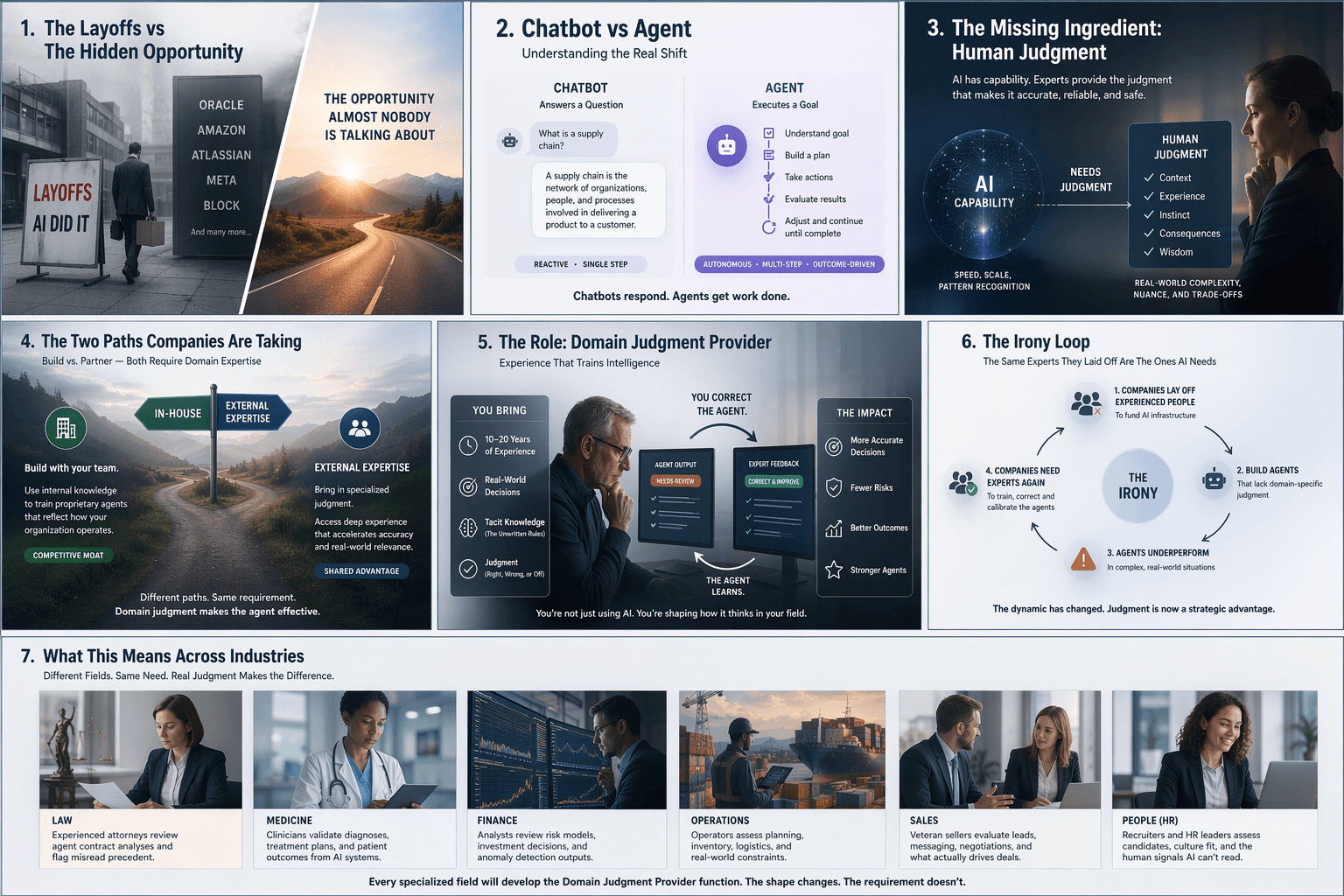
Everyone is watching the layoffs. Tens of thousands of jobs gone at Oracle, Amazon, Atlassian, Meta, Block. The headlines say AI did it. Companies say AI made it possible to do more with less. Analysts say the math works.
What almost nobody is talking about is the problem sitting directly underneath all of it.
AI agents are the autonomous systems companies are spending hundreds of billions of dollars to build and deploy. They do not work without human judgment to train them. Not generic human feedback. Not crowdsourced clicks. Deep, specialized, hard-won industry expertise. The kind that takes ten to twenty years to develop and cannot be scraped from the internet.
That creates something interesting. While one category of job is being eliminated, another is being quietly created. And right now almost nobody is positioning themselves to fill it.
First, understand what an agent actually is.
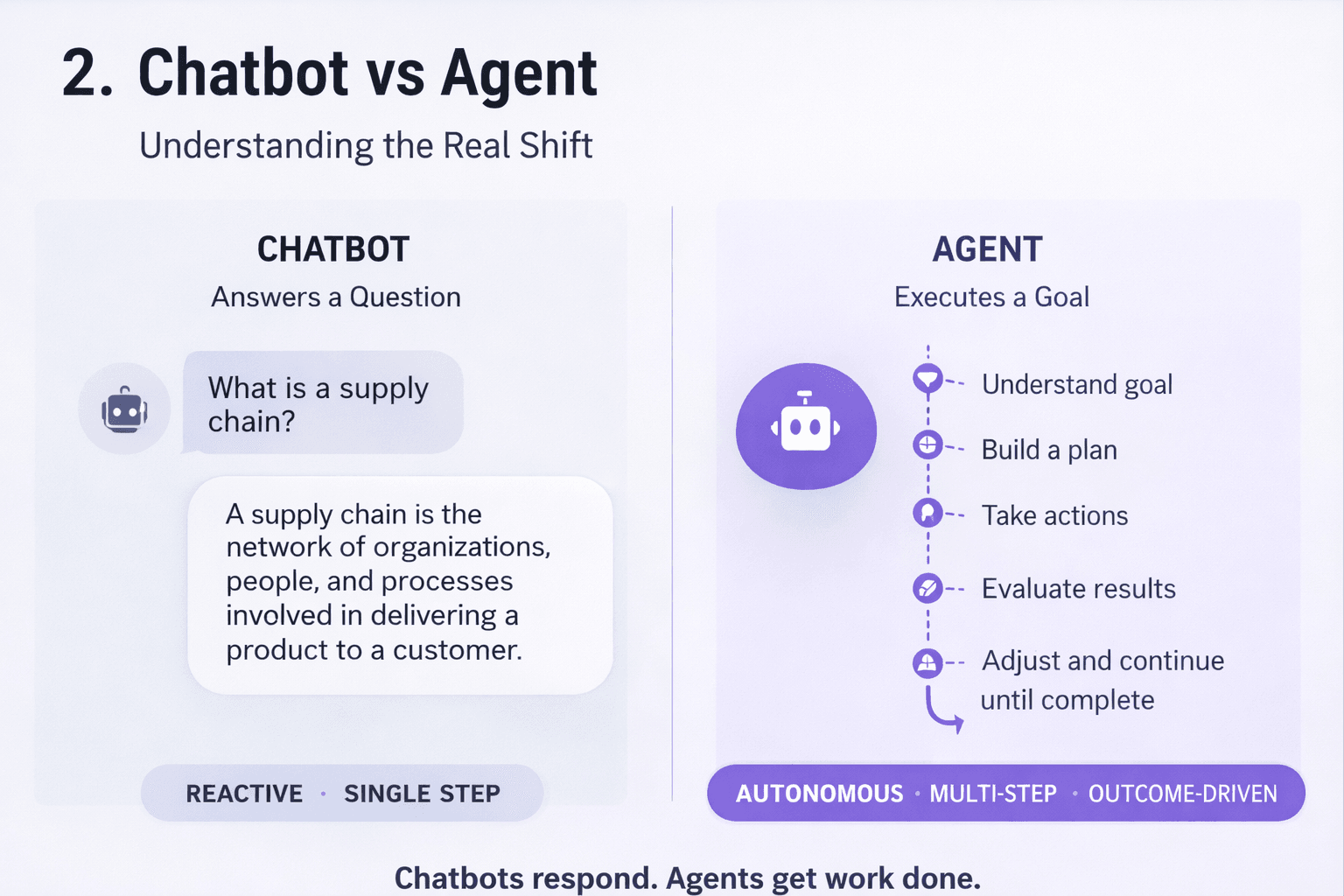
A chatbot answers a question. An agent executes a goal.
You give an agent a task. Research this market. Draft this contract. Screen these candidates. Optimize this supply chain. The agent builds its own plan. It takes actions. It evaluates results. It adjusts. It keeps going until the work is done. No hand-holding. No step-by-step instructions.
That capability is genuinely new. It is exactly what companies are building all this infrastructure for. Not smarter chatbots. Autonomous systems that can run business functions end-to-end, around the clock, at a cost of cents per hour.
The economic logic is clear. If an agent can do the work of a team and runs at a fraction of the cost, you build the agent. That is what the layoffs are funding.
An agent is only as good as the judgment baked into it. And right now, the judgment is the missing ingredient.
Here is the problem they are not advertising.

Agents are trained on general human knowledge. They are capable in broad terms. But general knowledge does not know how your sales process actually works. It does not know what a red flag looks like in your specific market. It does not know the unwritten rules that separate a sound decision from a costly one in your domain.
That gap has to be filled by a human. Specifically, a human who has operated in that domain long enough to carry real judgment. Not information. Judgment. The ability to look at an output and know, with authority, whether it is right, wrong, or subtly off in a way that will cause problems downstream.
This is not a small gap. It is the difference between an agent that works and an agent that confidently does the wrong thing. In high-stakes environments like hiring, legal, finance, medicine, and operations, confidently wrong is worse than useless.
The two paths companies are taking.
Path one is building it in-house. Companies with well-documented processes and institutional knowledge can work alongside AI to correct it, grade its outputs, and refine its behavior over time. Done well, this builds a proprietary agent that reflects how that specific organization operates. That becomes a competitive moat nobody can copy by buying the same software.
Path two is external expertise. This is where the opportunity lives for people outside the big tech ecosystem. A twenty-year underwriter does not get replaced by an agent. She becomes the person who decides when the agent’s risk assessment is wrong and why. That correction data is what makes the agent accurate over time. Her judgment is the training signal.
Both paths require the same thing. Domain experts willing to engage with AI systems as trainers, evaluators, and calibrators. Not as users. As architects of how the system learns to think inside a specific field.
The new function has a name.
It is not “AI trainer” in the generic sense. The generic version is already being commoditized. What I am describing is something more specific and more valuable.
Call it Domain Judgment Provider.
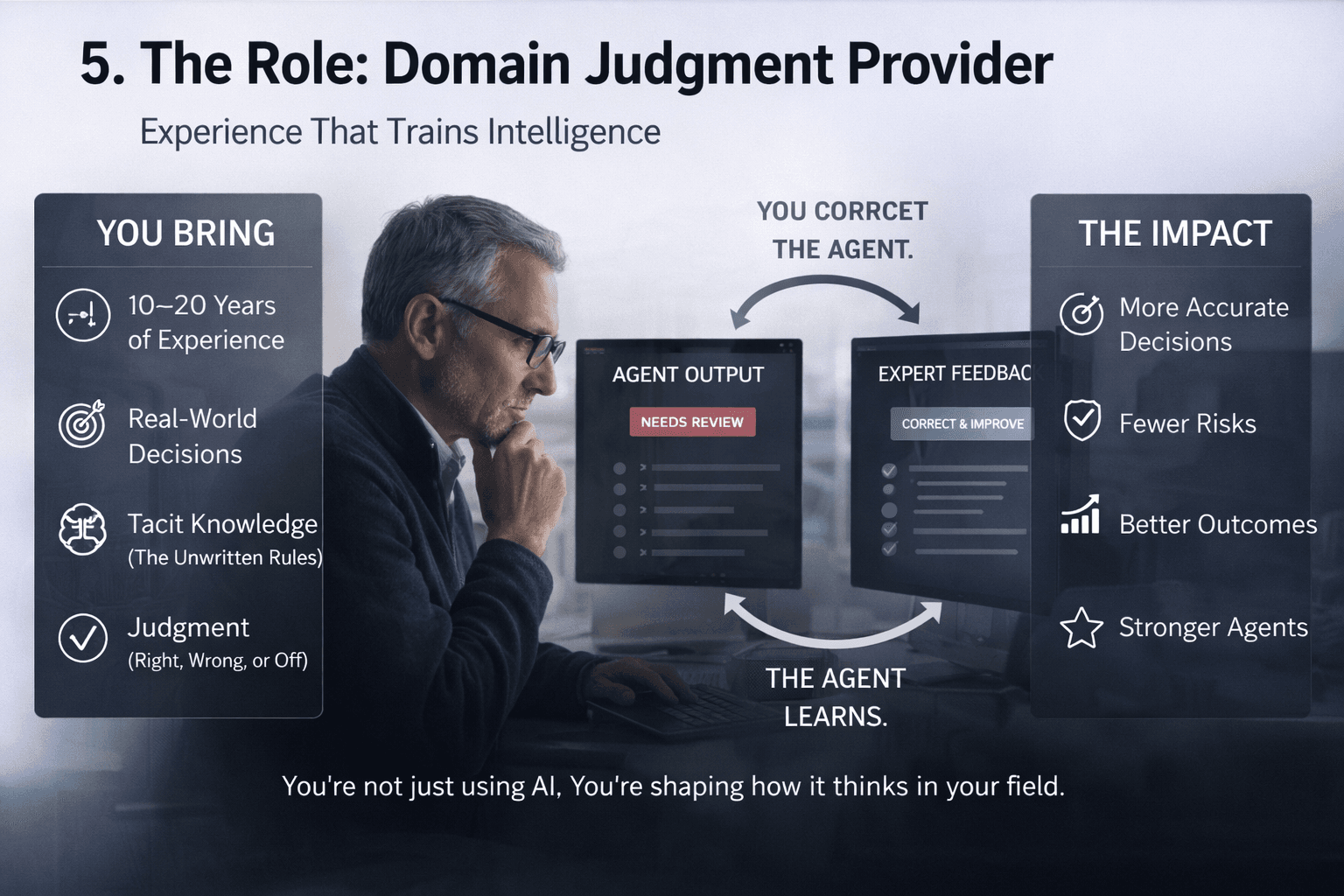
The job is this. You carry ten to twenty years of experience in a field. You review agent outputs. You flag what is wrong. You explain why it is wrong in terms the system can learn from. You encode the tacit knowledge that never made it into any training document because it lived in your head, built through years of real decisions with real consequences.
That knowledge is valuable precisely because it is inaccessible any other way. The internet has information. It does not have the instinct of someone who has closed five hundred deals and learned what the subtle warning signs look like three weeks before one falls apart.
Companies are laying off experienced people to fund AI infrastructure. Those same people hold the judgment the agents need to become useful.
Hiring for a role like this right now? One call is usually enough for us to tell you whether we can fill it.
Book a CallThe irony running through all of this.

Companies are eliminating experienced people to fund the infrastructure. That infrastructure is being used to build agents. Those agents underperform in domain-specific situations because they lack the judgment of the people who were eliminated. So the company then needs to find domain experts to fix the agents.
Except now the dynamic has changed. The expert is not competing for a job on the old terms. The company is dependent on the agent working. The agent only works well if someone with real judgment is feeding it corrections. That is leverage that did not exist before.
The experts who understand this early and position themselves accordingly are not defending against AI. They are becoming the ingredient that makes AI viable in their field.
What this means across industries.
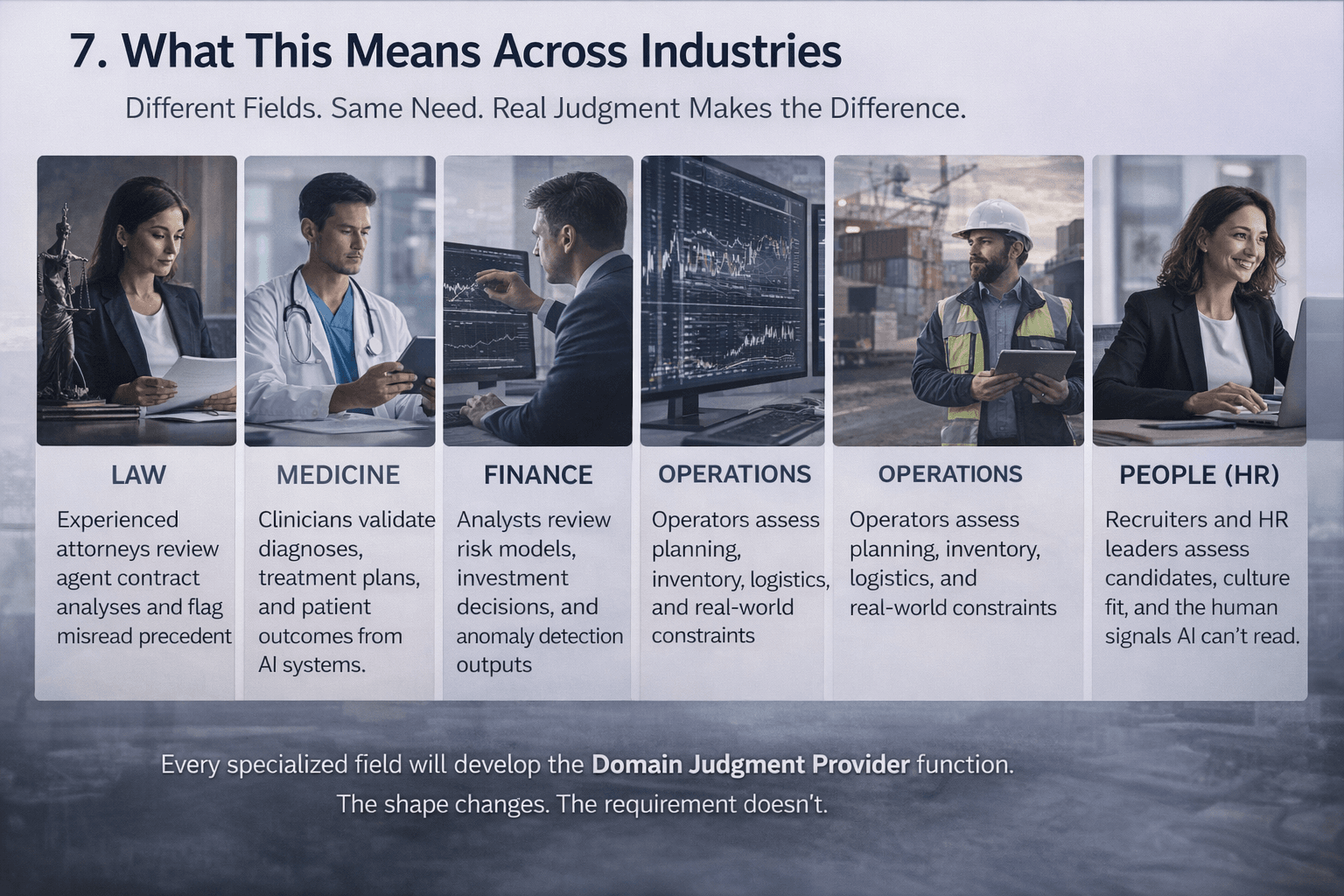
Every specialized field is going to develop this function. The shape changes but the requirement is the same.
In law, experienced attorneys review agent contract analyses and flag misread precedent. In medicine, clinicians review diagnostic outputs and correct for context the agent cannot see. In finance, senior analysts review agent-generated theses and correct for market regime context absent from training data. In operations, seasoned managers catch the moments when an optimization recommendation ignores ground truth that only comes from having managed a real crisis.
In staffing and hiring, which sits directly in TCE’s lane, the agents being built to screen candidates, assess fit, and surface risk are only as accurate as the hiring judgment training them. An agent does not yet know the difference between someone who articulates well and someone who actually builds well. That distinction, and the ability to teach it to a system consistently, is where experienced practitioners become essential infrastructure.
The positioning question.
The people who will benefit from this shift are not waiting to be asked. They are recognizing that their expertise is now a training asset, not just a professional credential. They are getting clear on what they actually know that cannot be found in a database. They are learning enough about how these systems work to communicate their judgment in ways the systems can absorb.
That is not a massive technical lift. It does not require becoming an engineer. It requires being specific about what you know and why it matters. Most experienced practitioners underdo this because the value of their knowledge has always been assumed by the organizations they worked inside.
That assumption is ending. The knowledge is now being externalized into systems. The people who actively participate in that process will shape how those systems behave. The people who do not will watch their expertise get approximated by something trained on someone else’s judgment.
The AI boom created a visible disruption. It also created a less visible opportunity.
The companies building agents need what the agents cannot generate on their own. They need people who have done the work long enough to know when something is right, when it is wrong, and what the difference costs.
That is not a defensive position. It is a foundational one.
The question is whether the people who carry that judgment will recognize it before the window closes.
Frequently Asked Questions

What is a Domain Judgment Provider?
A Domain Judgment Provider is an experienced professional who helps train, validate, and guide AI systems using real-world expertise. AI can process data, but it lacks context, experience, and judgment. This role ensures AI outputs reflect real-world decision-making.
Why can’t AI systems make decisions on their own?
AI systems operate on patterns and data, not lived experience. They cannot: • Understand nuance • Interpret context fully • Anticipate real-world consequences Without human judgment, AI decisions can be incomplete or flawed.
What’s the difference between a chatbot and an AI agent?
A chatbot answers questions based on prompts. An AI agent: • Plans tasks • Executes actions • Evaluates outcomes • Adjusts behavior Agents operate closer to real work, which increases the need for human oversight.
Why are companies laying off employees while investing in AI?
Companies are reallocating resources toward automation and AI infrastructure. The assumption is that AI can replace certain roles. However, this often overlooks the need for experienced professionals to guide and refine those systems.
What is the “Irony Loop” in AI adoption?
The Irony Loop describes a cycle: 1. Companies lay off experienced professionals 2. Build AI systems 3. Systems underperform 4. Companies need those same experts again AI depends on the expertise it initially replaced.
What does a Domain Judgment Provider actually do?
They: • Train AI systems using domain knowledge • Validate outputs for accuracy • Correct flawed decisions • Guide how AI is applied in real scenarios They act as the bridge between technical systems and real-world execution.
Which industries need Domain Judgment Providers?
This role applies across industries, including: • Law • Medicine • Finance • Operations • Sales • Human Resources Any field that involves decision-making will require human judgment alongside AI.
How much experience is needed for this role?
Typically, 10–20 years of domain experience. This level of experience provides: • Pattern recognition • Context awareness • Decision-making maturity These are qualities AI cannot independently develop.
Is this a new job or a shift in existing roles?
It is both. Some professionals will transition into this role within companies, while others will offer it externally through consulting or advisory work.
Why is judgment becoming a competitive advantage?
As AI becomes more widespread, access to technology becomes equalized. What differentiates companies is: 👉 How well they apply it Judgment determines: • What decisions AI makes • When to trust it • When to override it
Will AI eventually replace the need for human judgment?
No. AI can improve with feedback, but it cannot fully replace: • Experience • Contextual awareness • Ethical reasoning Human judgment remains foundational to effective decision-making.
How should professionals position themselves in this shift?
Professionals should: • Focus on developing deep domain expertise • Learn how AI systems operate • Position themselves as decision-makers, not just executors The opportunity is not in competing with AI, but in guiding it.
Hiring right now? Let's talk.
Book a 20-minute call with The Chum Effect. Bring the role you are struggling to fill and we will tell you honestly whether we can help, including when we are not the right fit.
Related articles
The Everyday Thinking Partner Rule
A simple rule for using AI without losing your judgment: let it clarify your thinking, not decide for you. Clearer mind. Same responsibility.
Why Smart People Are Making Worse Decisions With AI
AI doesn’t make decisions reckless—it makes them feel complete too soon. This article examines why intelligent thinkers are especially vulnerable.
AI Is Not a Tool Upgrade. It’s an Organizational Maturity Test
AI is more than just an upgrade—it's a crucial organizational maturity test. This article explores how AI can amplify decision velocity and the risks of scaling it before ensuring your organization’s structural readiness. Learn why understanding your internal processes is key to successful AI integration.
Why Early Decisions Require Friction, Not Speed
Moving fast feels productive, but early decisions shape everything that follows. This piece explains why slowing down creates better outcomes.
Why Trust Is the Only Real Hiring Asset
Interviews, data, and tools can look perfect on paper. This piece explains why trust is what actually holds hiring systems together.
Why Companies Lose Market Relevance — And How Leaders Respond
Profitability and scale can hide a deeper problem. This article explores how capable companies lose relevance—and what leadership must change to matter again.


