


AI Is Not a Tool Upgrade. It’s an Organizational Maturity Test
February 8, 2026 • 5 mins read
Quick Answer
AI is not simply about scaling operations but enhancing the existing systems, processes, and decisions within an organization. It acts as a catalyst for organizational maturity, ensuring that structures are ready to absorb and adapt to the accelerated decision-making and accountability AI introduces.

By Chukwudum “Chumze” Chukwudebelu
Founder/CEO, TheChumEffect Creator of the BAAB Framework

Introduction
Most organizations moving aggressively to “scale AI” are operating under a quiet assumption:
That intelligence can be deployed faster than organizations can adapt to it.
This assumption is rarely stated out loud, but it sits underneath many AI initiatives today. Leaders talk about workflows, automation, agents, and transformation timelines, yet often skip a more fundamental question:
Can the organization safely absorb what AI introduces?
Because the real risk is not whether AI works.
The real risk is whether the organization is structurally mature enough to survive the mistakes AI will inevitably surface.
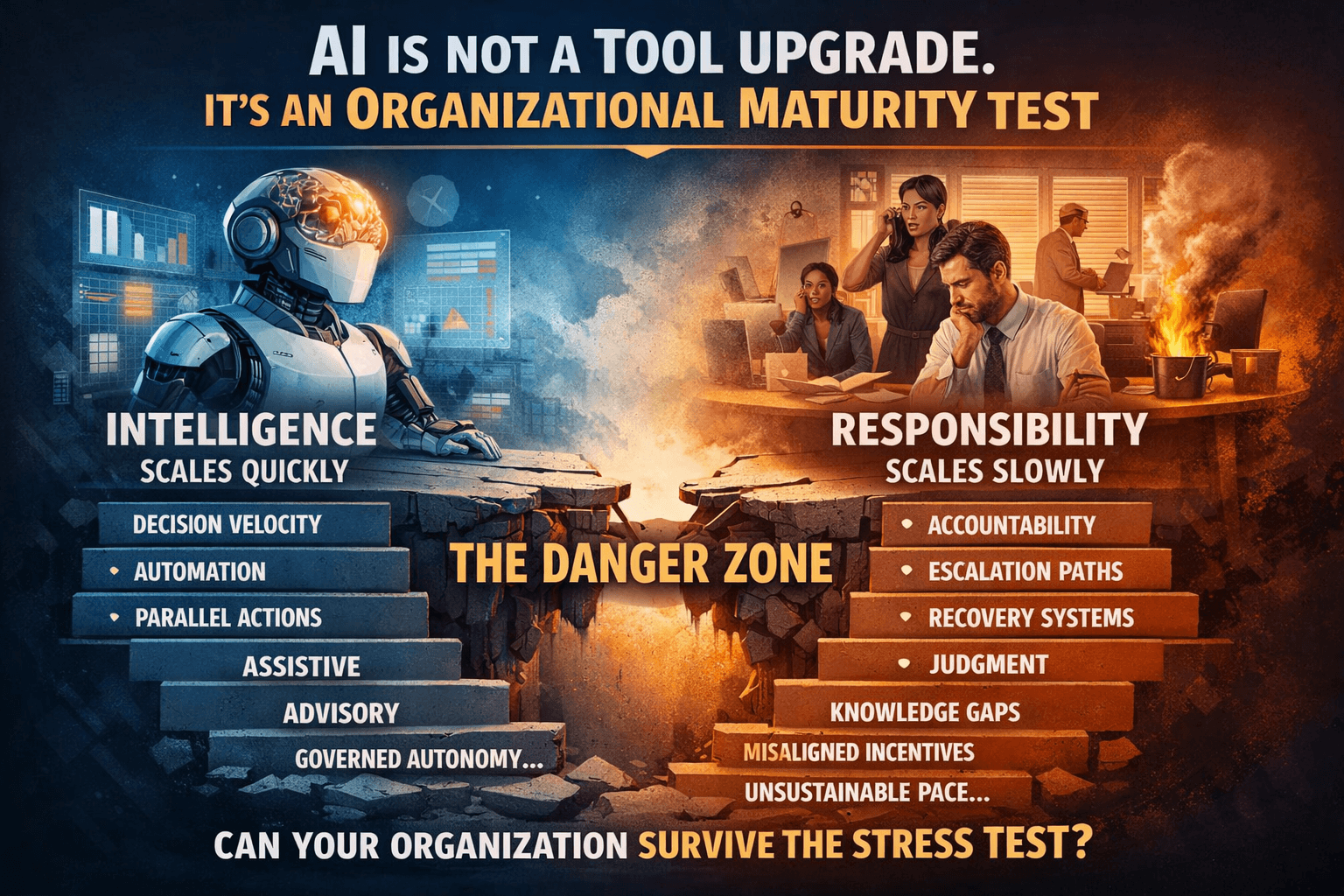
You Cannot Scale Intelligence Faster Than Responsibility
AI dramatically increases decision velocity.
It removes friction that once slowed actions down.
It multiplies the number of decisions that can be made simultaneously.
But responsibility, accountability, and recovery systems do not scale at the same rate.
They are human systems. They depend on clarity, ownership, escalation paths, and judgment. Those things mature slowly.
When decision velocity outpaces responsibility, failure does not happen all at once. It accumulates quietly.
Errors compound. Misalignments go unnoticed. Confidence grows faster than understanding. By the time leadership recognizes something is wrong, the organization is already reacting to second-order effects rather than causes.
This is not a technology problem.
It is a maturity problem.
Why “Scaling AI” Is the Wrong Mental Model
Many organizations treat AI like software.
Software can be rolled out.
Software can be copied.
Software scales cheaply.
Intelligence does not.
Intelligence requires judgment.
Judgment requires context.
Context requires understanding how work actually gets done.
AI does not replace work.
It exposes whether the organization understands its own work.
When leaders say they want to “scale AI,” what they often mean is that they want to accelerate outcomes without first stabilizing the systems that produce those outcomes. That gap is where most AI initiatives fail.
AI Has Developmental Stages — Ignoring Them Is Where Collapse Begins
AI capabilities do not arrive fully formed. They mature in stages. Ignoring those stages creates instability.
Assistive AI (Low Risk, Reversible)
At this stage, AI retrieves information, summarizes content, checks outputs, and supports human decision-making. Humans remain fully responsible. Mistakes are easy to reverse.
Advisory AI (Human-in-the-Loop)
AI begins recommending actions and surfacing patterns. Humans still approve execution. Feedback loops start forming.
Supervised Execution
AI executes bounded actions. Humans audit outcomes. Clear kill-switches exist. Exceptions are expected and planned for.
Governed Autonomy
AI operates across workflows. Oversight replaces task execution. Metrics and audits replace intuition.
Most organizations attempt governed autonomy while still operating structurally at the assistive stage.
That mismatch is not innovation. It is overreach.
The Hidden Bottleneck: Knowledge Transfer, Not Models
AI does not learn in a vacuum. It learns from people.
Senior expertise is expensive.
Institutional knowledge is fragmented.
Critical judgment lives in undocumented decisions, edge cases, and experience.
Training AI requires extracting that knowledge. That extraction consumes human time, especially from the people who are already most valuable to the organization.
This is why early AI investments often look inefficient. They are not automation. They are knowledge extraction.
Productivity frequently drops before it rises. This phase cannot be skipped. Organizations that try to shortcut it do not save time. They delay failure.
Why Mishaps Are Inevitable — and Why Most Organizations Can’t Absorb Them
Mishaps are not a sign of failure. They are a normal part of AI maturation.
Data drifts.
Edge cases appear.
Systems optimize the wrong proxy.
Errors surface silently.
The real danger is not mishaps themselves. It is the absence of systems to absorb them.
Many organizations lack:
- Clear escalation paths
- Defined ownership
- Rollback discipline
- Cultural permission to intervene
AI systems rarely fail catastrophically. They fail gradually, until the organization no longer understands what it is seeing.
Hiring for a role like this right now? One call is usually enough for us to tell you whether we can fill it.
Book a CallWhen Incentives Distort AI Timelines
Even mature organizations can rush AI adoption for reasons unrelated to readiness.
In some cases, market pressure rewards visible innovation signals more than operational stability. In others, transaction or exit dynamics shorten time horizons and elevate narrative over durability.
This is not bad faith. It is incentive distortion.
When speed is rewarded more than survivability, discipline erodes. AI timelines become shaped by external expectations rather than internal maturity.
In many organizations, AI timelines are set by markets and transactions, not by organizational readiness.
What Actually Changes for Humans (And What Doesn’t)
AI does not eliminate humans. It changes what humans are responsible for.
Humans move from executing tasks to supervising systems.
That shift requires new skills:
- Boundary setting
- Exception handling
- Outcome evaluation
- Governance and judgment
AI never works on its own. It works under supervision, governance, and constraint — permanently.
Organizations that treat AI as a replacement rather than a responsibility multiplier misunderstand what they are building.
The Time Horizon Leaders Consistently Underestimate
Real AI integration takes years.
Organizational learning is slow.
Trust forms through repeated cycles.
Governance matures through controlled failure.
Culture lags strategy.
There is no fast path to safe autonomy.
AI transformation is not a rollout. It is institutional maturation.
The Real Question Leaders Should Be Asking
The wrong questions sound like:
- How much AI should we deploy?
- How fast can we automate?
- How many workflows can we replace?
The right question is simpler and harder:
What level of responsibility, judgment, and recovery can our organization actually sustain right now?
Like any system that grows, AI capabilities must mature in stages. When intelligence grows faster than structure, instability is inevitable.
The Test That Never Lies
If an organization cannot clearly explain how work gets done, why decisions are made, and who owns failure, no amount of AI will fix that.
AI does not create maturity.
It reveals whether it already exists
Hiring right now? Let's talk.
Book a 20-minute call with The Chum Effect. Bring the role you are struggling to fill and we will tell you honestly whether we can help, including when we are not the right fit.
Related articles
The Everyday Thinking Partner Rule
A simple rule for using AI without losing your judgment: let it clarify your thinking, not decide for you. Clearer mind. Same responsibility.
Why Smart People Are Making Worse Decisions With AI
AI doesn’t make decisions reckless—it makes them feel complete too soon. This article examines why intelligent thinkers are especially vulnerable.
The New Job the AI Boom Just Created
AI isn’t just replacing jobs — it’s creating a new one. Companies still need experienced professionals to train and guide AI systems. This is the rise of the Domain Judgment Provider.
Why Early Decisions Require Friction, Not Speed
Moving fast feels productive, but early decisions shape everything that follows. This piece explains why slowing down creates better outcomes.
Why Trust Is the Only Real Hiring Asset
Interviews, data, and tools can look perfect on paper. This piece explains why trust is what actually holds hiring systems together.
Why Companies Lose Market Relevance — And How Leaders Respond
Profitability and scale can hide a deeper problem. This article explores how capable companies lose relevance—and what leadership must change to matter again.


